How to Build a High-Converting Website for a Negombo Hotel, Restaurant or Tourism Business
Getting travellers to your website is only the first step. This guide covers what happens after they arrive: the fifteen design and technical decisions that turn a Negombo hotel, restaurant, tour or watersports visitor into an enquiry, and an enquiry into a booking.
Uniix Studio
Creative Digital Agency
In brief
- Traffic, enquiries and bookings are three separate problems. Most tourism websites only work on the first.
- Visitors convert when they can quickly see the offer, understand the price, check availability and ask a question on WhatsApp.
- A direct-booking strategy works alongside OTAs. The website's job is to make booking direct the easier and better-value choice.
Contents
- 01What makes a hotel or tourism website convert?
- 02Traffic, enquiry, booking: three different problems
- 03Stage one: the first few seconds
- 04Stage two: deciding
- 05Stage three: acting
- 06Stage four: being found
- 07Stage five: the direct-booking strategy
- 08Practical examples by business type
- 09Measuring the journey from visit to booking
- 10Where to start
Negombo tourism businesses rarely lack visitors. The town sits close to Bandaranaike International Airport, and travellers look it up constantly, whether for a first night after landing, a last night before a flight, a seafood dinner, a lagoon tour or a dive. The harder question is what happens once someone reaches your website.
Our Negombo web design page covers why the local market rewards direct bookings and strong Google Maps visibility. This guide goes further. It's about how the website itself should be designed so that a visitor becomes an enquiry, and an enquiry becomes a confirmed booking.
It applies to hotels, guesthouses and villas along the beach strip and Poruthota, restaurants, tour operators, diving and watersports schools, wellness and Ayurveda businesses, and travel companies.
What makes a hotel or tourism website convert?
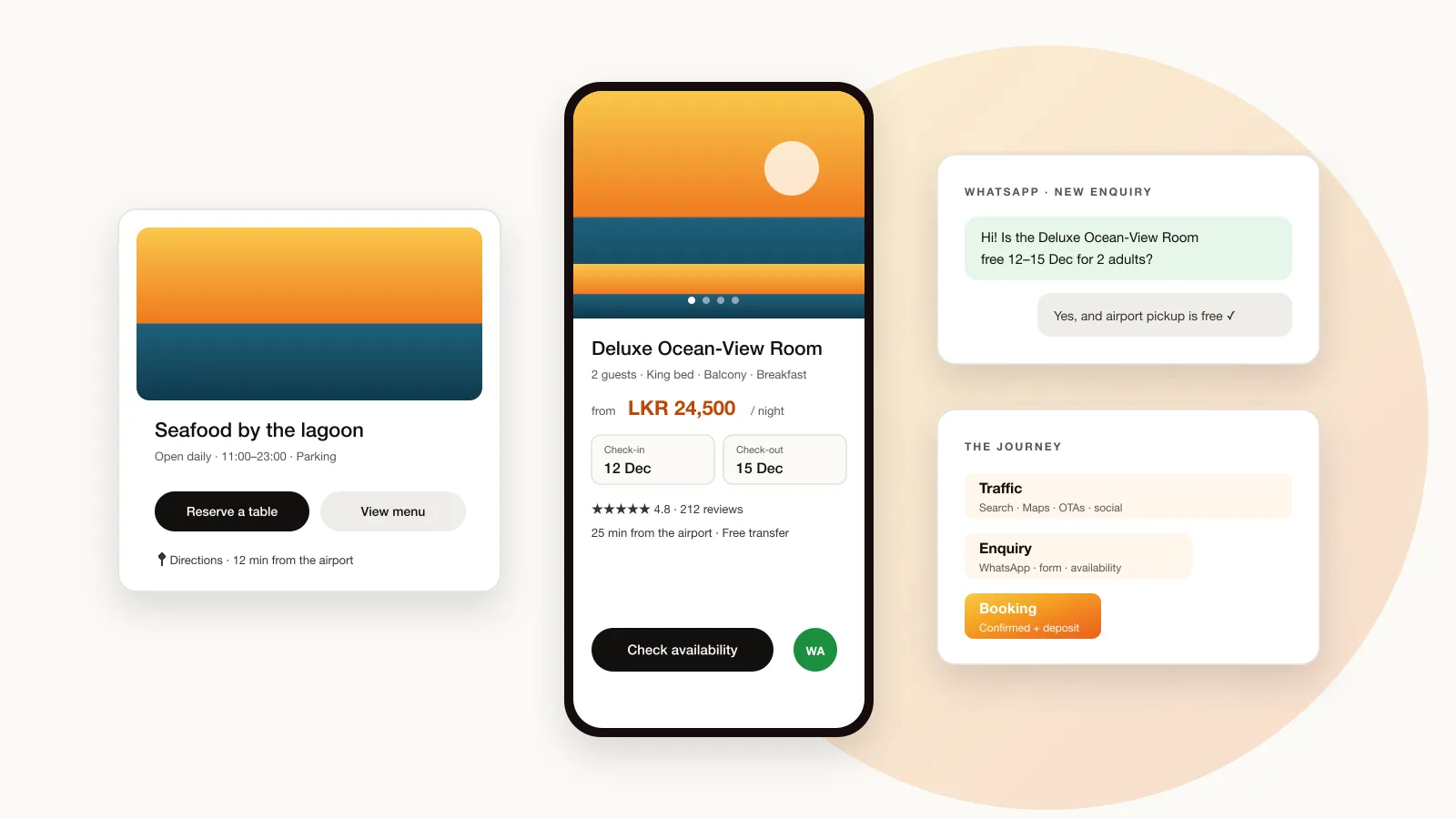
A tourism website converts when a traveller on a phone can quickly see what you offer, trust that it's real, understand roughly what it costs, check whether it's available for their dates, and act, whether that means booking, sending a WhatsApp message or reserving a table, without friction. Speed, photography, clear pricing, visible reviews and one obvious next step do most of the work.
Everything below expands on that answer.
Traffic, enquiry, booking: three different problems
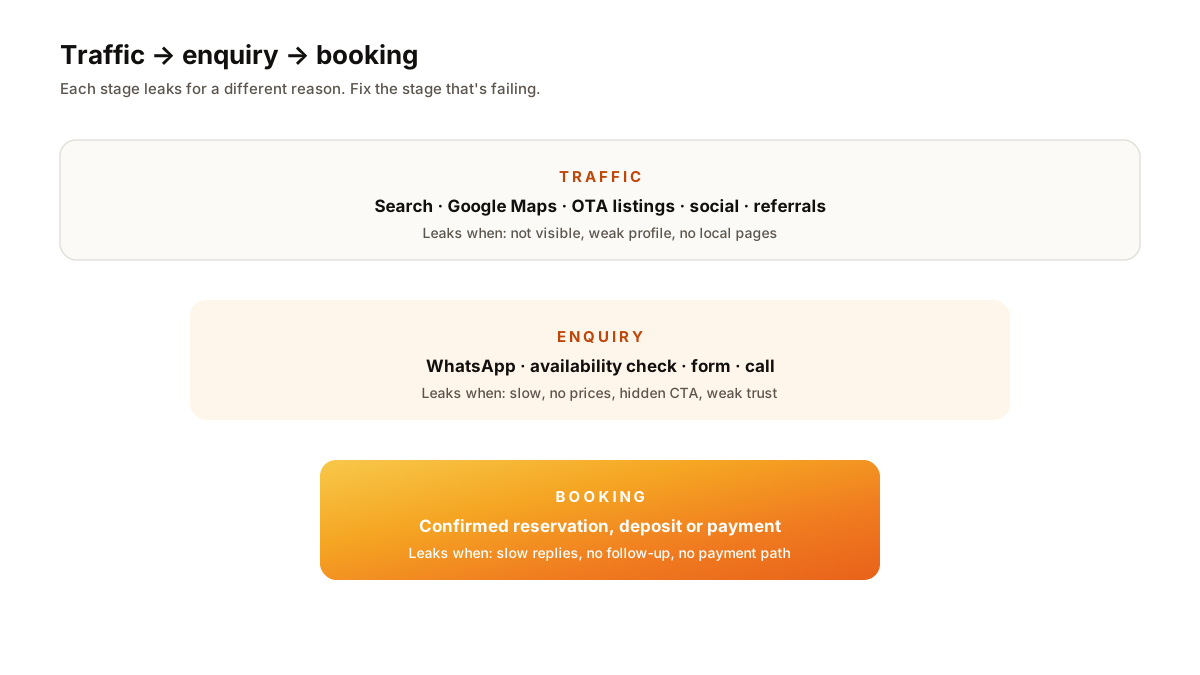
It helps to separate the journey into three stages, because each fails for different reasons.
- Traffic is people arriving at your site from Google Search, Google Maps, social media, OTA listings, guidebooks or word of mouth. This is mainly a visibility problem.
- Enquiry is a visitor taking a first action: a WhatsApp message, a form, a call or an availability check. This is mainly a design and trust problem.
- Booking is a confirmed reservation, often with a deposit or payment. This is mainly a process and follow-up problem.
A property can have healthy traffic and very few enquiries because the site is slow, vague about pricing or hides the contact options. Another might get plenty of enquiries but few bookings because replies are slow or there's no simple way to secure the dates.
An illustrative example. Picture a twelve-room guesthouse near the beach. It gets a steady stream of visits from its Maps listing, but the website shows a slider, a long welcome paragraph and a contact form at the bottom of the page. On a phone, a traveller sees no rooms, no prices and no WhatsApp button in the first screen. Most leave. The fix isn't more traffic. It's putting rooms, a "from" rate and a WhatsApp button in the first screen, then making the reply process fast and consistent.
Stage one: the first few seconds
1. A fast mobile experience
Many travellers look you up on a phone, often on mobile data, roaming or airport Wi-Fi. If the first screen takes too long, they go back to the search results. Aim for Google's Core Web Vitals thresholds: main content visible within 2.5 seconds, responsive interactions, and no layout jumping as images load.
In practice that means a lightweight template, a hero image sized properly for mobile, and no autoplaying background video that the phone has to download before anything else.
2. Visual storytelling
Travellers buy with their eyes. Professional photography of your actual rooms, food, views, boats and people does more for conversion than any headline. Sequence images as a story: arrival, the room, the details that matter (bathroom, balcony, pool), the setting, the experience.
Avoid stock photos of generic beaches. Guests notice, and it undermines trust when they arrive.
3. Image optimisation
Good photography only helps if it loads. Serve modern formats such as WebP or AVIF, size images to the screen they're displayed on, lazy-load images below the first screen, and give each one descriptive alt text. That supports accessibility and helps images appear in Google Images, as its image SEO guidance explains.
Stage two: deciding
4. Clear presentation of rooms, dishes or experiences
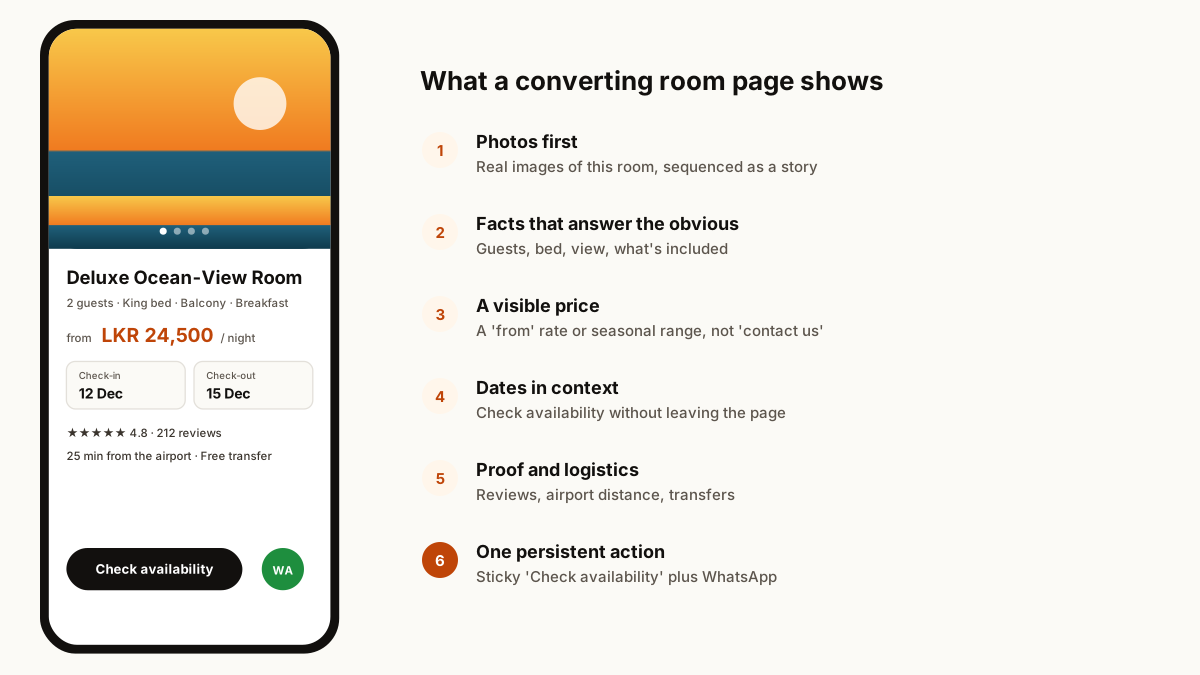
Each room type, tour or package deserves its own section or page with the facts people compare: size, bed configuration, view, maximum guests, what's included, and photos of that specific room. For restaurants, that means a readable menu page (not only a PDF), signature dishes and opening hours. For tour and dive operators, it means duration, pickup points, what's included, skill level and group size.
5. Clear pricing, or a clear enquiry flow
Uncertainty about price is one of the main reasons visitors leave without acting. Show a rate, a "from" price or a seasonal range. If pricing truly depends on dates or group size, explain what affects it and make the enquiry the obvious next step.
6. Reviews and testimonials
Travellers rely heavily on what previous guests say. Show selected reviews on the site with the reviewer's first name and country or source, and link to your Google and TripAdvisor profiles so visitors can check them independently. Don't invent, edit or selectively reword reviews. It breaks trust and platform rules.
7. Trust signals
Beyond reviews, show the details that reassure a traveller booking from abroad: your registration with the Sri Lanka Tourism Development Authority where applicable, a physical address, secure payment, clear cancellation and refund terms, response-time expectations, and real photos of your team.
Stage three: acting
8. A direct booking call to action
Every important page needs one primary action. For hotels, that's "Check availability" or "Book direct". For restaurants, "Reserve a table". For tours, "Book this tour" or "Ask about dates". On mobile, a sticky bar at the bottom of the screen keeps the action within thumb reach without covering content.
9. WhatsApp
WhatsApp is one of the most natural contact channels for many travellers and for Sri Lankan businesses. Use a click-to-chat button with a pre-filled message that includes the room, tour or date the visitor was looking at. That turns a vague "hi" into a message your team can answer immediately. Track WhatsApp clicks as a conversion so you can see which pages generate them.
10. Availability and enquiry forms
If you use a booking engine, integrate it so availability and rates show on your site without sending people to a confusing third-party page. If you don't, use a short enquiry form: dates, number of guests, room or experience, and preferred contact method. Confirm receipt immediately and tell the guest when to expect a reply.
11. Google Maps and getting there
Show your location clearly: an embedded map, the written address, distance and typical travel time from the airport, and transfer options. For a restaurant, add parking and landmarks. This is decision information, not a footer detail. A traveller choosing a first-night stay near the airport cares about exactly this.
Stage four: being found
12. Local SEO
Your website and your Google Business Profile support each other. Make sure your name, address and phone number match exactly across both, that the website has a page for each core offering, and that pages describe your location naturally. Our article on local SEO and web design in Gampaha explains how these signals fit together, and our SEO services cover the technical side.
13. Structured data (schema)
Structured data helps search engines understand what your business is. Use the most specific schema.org type that fits, such as Hotel or another LodgingBusiness type, Restaurant or TouristTrip, with your name, address, geo-coordinates, opening hours, price range and contact details, following Google's LocalBusiness structured data documentation. Mark up only information that's visible on the page. Never add review ratings you can't substantiate.
14. Multilingual readiness
Negombo attracts visitors from many countries, but translating a whole site badly is worse than one excellent language. Build the site so extra languages can be added cleanly later, with separate URLs per language and correct hreflang annotations. Add a language when booking data shows real demand.
Stage five: the direct-booking strategy
15. Making direct the better choice
A direct-booking strategy isn't about abandoning OTAs. They bring travellers who would never have found you. The strategy is to make booking direct the easier, better-value choice for people who already know your name: returning guests, referrals, and people who found you on Google or Maps.
Practical levers include:
- Added value for direct bookings (airport pickup, breakfast, late checkout, a welcome drink) rather than simply lower prices. Check your OTA contracts for any rate-parity terms.
- Flexible cancellation for direct bookings where you can offer it.
- A fast, personal reply on WhatsApp.
- Connecting your booking engine to Google so your official site can appear alongside OTAs in hotel search, through Google's Hotel Center programme and a supported connectivity partner.
- Collecting guest emails (with consent) for return-visit offers.
Our guide to hotel website design in Sri Lanka covers booking engines and the economics of direct bookings in more depth.
Practical examples by business type
| Business | Primary conversion | Most important page | Key detail visitors look for |
|---|---|---|---|
| Hotel / guesthouse / villa | Direct booking or availability check | Room pages | Photos, rate, what's included, airport distance |
| Restaurant | Table reservation or directions | Menu page | Menu with prices, hours, location, parking |
| Tour operator | Tour booking or date enquiry | Tour detail pages | Duration, inclusions, pickup, price per person |
| Diving / watersports | Course or session booking | Course pages | Certification level, schedule, safety, equipment |
| Wellness / Ayurveda | Treatment booking | Treatment pages | Treatment details, duration, practitioner, price |
For restaurants specifically, our restaurant website design guide covers online ordering and reservations in more detail.
Measuring the journey from visit to booking
You can't improve what you can't see. Set up tracking for each stage:
- Traffic: Search Console for search visibility, analytics for sources, UTM tags on social and email links.
- Enquiries: form submissions, WhatsApp clicks, phone taps and booking-engine starts, tracked as conversion events.
- Bookings: confirmed bookings from the booking engine, plus a simple "how did you find us?" question at check-in or in the confirmation message.
Compare them monthly. If enquiries rise but bookings don't, look at response times and follow-up. If traffic is healthy but enquiries are low, look at the site.
Where to start
Open your website on your phone, on mobile data, and try to book a room, reserve a table or ask about a tour as if you were a stranger. Time it and note every moment of doubt. That list is your brief.
If you're planning a new site, our web design team can map the booking journey first and design around it, and our Negombo web design service page covers local hospitality projects specifically. If you already have a site and suspect it's underperforming, the ten signs a website needs a redesign is a useful self-check.
Uniix Studio is a Colombo-based creative digital agency that designs and builds websites for hotels, restaurants, tour operators and tourism businesses in Negombo, Katunayake and across Sri Lanka's west coast.
Frequently asked questions
Should a Negombo hotel have its own booking website?
Yes, alongside OTA listings rather than instead of them. OTAs bring discovery, but every booking carries commission and the guest relationship belongs partly to the platform. A fast, trustworthy website with a clear booking or enquiry flow lets returning guests, referrals and people who find you on Google or Maps book direct.
Do I still need Booking.com or Airbnb if I have a good website?
For most properties, yes. OTAs are powerful discovery channels, especially for international travellers. The aim is balance: use OTAs for reach, and use your website, Google Business Profile and guest communication to make direct booking the easier, better-value option for people who already know your name.
Should I show room rates on my hotel website?
Showing rates, or at least a 'from' price, usually helps conversion because travellers want to know whether you're in their budget before they enquire. If rates vary heavily by season, show a range with seasonal notes or connect a booking engine that shows live prices. Check any rate-parity terms in your OTA contracts before advertising lower direct rates.
Is WhatsApp a good way to take bookings?
WhatsApp works well for enquiries, questions and personal service, and many travellers prefer it. For confirmed bookings, pair it with a clear process: a booking engine, a payment or deposit link, and written confirmation. That way you don't lose track of reservations or take on payment risk.
Does a Negombo tourism website need to be multilingual?
Not necessarily at launch. Start with excellent English and a structure that can support more languages later. Add a language when you have evidence of demand, for example a large share of guests from one market, and when you can maintain properly translated content with correct hreflang tags.
Can a restaurant in Negombo take reservations through its website?
Yes. Options range from a simple reservation form or WhatsApp request to a dedicated table-booking system with confirmations. Whichever you choose, show opening hours, menu, location and parking clearly, because those are the details people check before they book.
How much does a hotel or tourism website cost in Sri Lanka?
It depends on scope: number of rooms or products, booking engine integration, languages and content production. A polished single-property website sits in a different band from a multi-property platform with live availability. Our Sri Lankan website cost guide gives typical 2026 ranges by project type.
Related services
Where Uniix Studio can help
Web Design
Fast, brand-led, conversion-focused websites built on modern stacks.
Web Development
Next.js, WordPress, headless and bespoke builds.
SEO Services
Technical SEO, content clusters, local SEO, AEO and GEO for 2026.
UI/UX Design
User-centred design for web and mobile that turns visitors into customers.
Next step
Planning a hotel, restaurant or tourism website?
Start with the booking journey, not the homepage. Tell us how guests find you and book today, and we'll map the path from first visit to confirmed booking.