Website Redesign in Kandana: 10 Signs Your Business Website Needs an Upgrade
Most business websites in Kandana aren't broken. They're quietly underperforming: slow on phones, vague about the next step, invisible on Google. Here are ten signs to check, and what a real redesign fixes that a new colour scheme doesn't.
Uniix Studio
Creative Digital Agency
In brief
- If your site is slow on mobile, unclear about the next step, or produces no measurable enquiries, it needs more than a visual refresh.
- A real redesign covers UX, content, technical SEO, performance, accessibility and tracking, and it protects the rankings you already have.
- Score your site against the ten signs below before you brief anyone. It will tell you whether to refresh, rebuild or replatform.
Contents
- 01How do you know if your website needs a redesign?
- 02A redesign is not a new colour scheme
- 03The 10 signs your business website needs an upgrade
- 04Refresh, rebuild or replatform?
- 05What a proper redesign includes
- 06How to redesign without losing your Google rankings
- 07What this looks like in practice
- 08Where to start
Most business websites in Kandana aren't broken. They load, the phone number works, and the "About Us" page says roughly the right things. The problem is quieter: the site was built for how the business worked five years ago, on the assumption that people browse on desktops, by someone who has since moved on.
Kandana sits on the A3 between Ja-Ela and Wattala, a few minutes from Ragama. For businesses here, the website is often the first thing a customer checks before deciding whether to call you or a competitor closer to Colombo. If it looks dated, loads slowly on a phone or makes the next step unclear, that customer goes elsewhere, and you never find out.
This guide covers ten signs that a business website needs a redesign, what each one costs you, and why fixing them properly means more than new colours.
How do you know if your website needs a redesign?
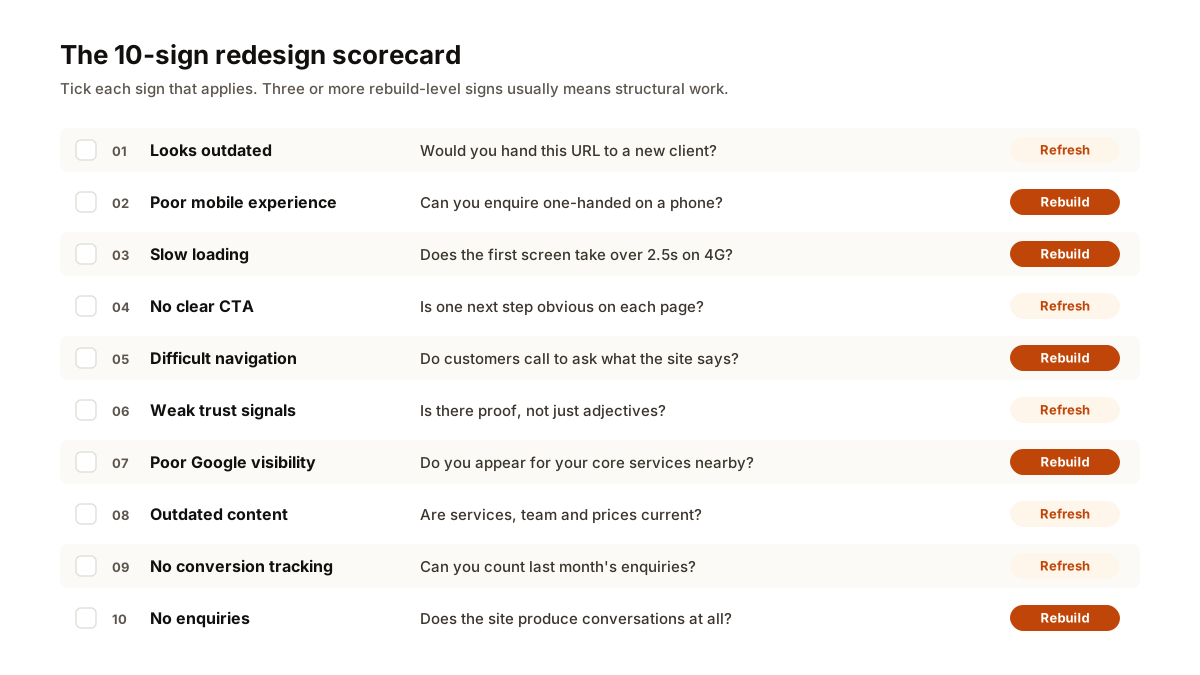
Your website probably needs a redesign if it's slow or awkward on mobile, has no clear call to action, is hard to navigate, lacks trust signals, doesn't appear for searches you should win, or produces enquiries you can't measure. If three or more of the ten signs below apply, a visual refresh won't be enough. The structure needs work.
Before going through them, one principle matters more than any single sign.
A redesign is not a new colour scheme
When business owners say "redesign", they often mean a new look: fresh colours, a new font, bigger photos. Sometimes that's exactly right. More often, the look is the symptom people notice, and the real problems sit underneath it.
A website has layers:
- Strategy: who it's for and what it should get them to do.
- Information architecture: how pages are organised and how people find things.
- Content: what the pages say and show.
- Interface: the visual design and interaction.
- Technology: the CMS, code, hosting and performance.
- Measurement: analytics and conversion tracking.
Repainting the interface layer while the layers below stay broken produces a nicer-looking site that performs the same. That's why redesigns sometimes disappoint.
The 10 signs your business website needs an upgrade
1. The website looks outdated
People judge credibility quickly and visually. Tiny text, cramped layouts, stock photos of handshakes, a copyright year from 2019 and inconsistent fonts all signal "this business may not be active". That's especially risky when the customer is comparing you with a competitor in Wattala or Colombo whose site looks current.
What fixing it involves: a design system (type, colour, spacing and components used consistently), real photography, and a layout that puts the most important information first.
2. The mobile experience is poor
Google primarily uses the mobile version of a site for indexing and ranking, as its mobile-first indexing documentation explains. Most of your visitors are probably on phones too. Signs of trouble include pinching to zoom, buttons too close together, menus that don't open, and forms that are painful to fill in on a small screen.
What fixing it involves: designing mobile-first, with thumb-reachable actions, readable type without zooming, tap-to-call and WhatsApp, and forms with the right keyboard for each field.
3. It loads slowly
Slow sites lose visitors before the first screen appears, especially on mobile data. Google's Core Web Vitals set useful targets: Largest Contentful Paint within 2.5 seconds, Interaction to Next Paint under 200 milliseconds, and Cumulative Layout Shift under 0.1. Common causes include oversized images, heavy page builders, too many plugins, cheap hosting and third-party scripts.
What fixing it involves: image optimisation (modern formats, correct dimensions, lazy loading), lighter templates, better hosting and removing scripts that don't earn their place. Sometimes that means a new platform.
4. There's no clear call to action
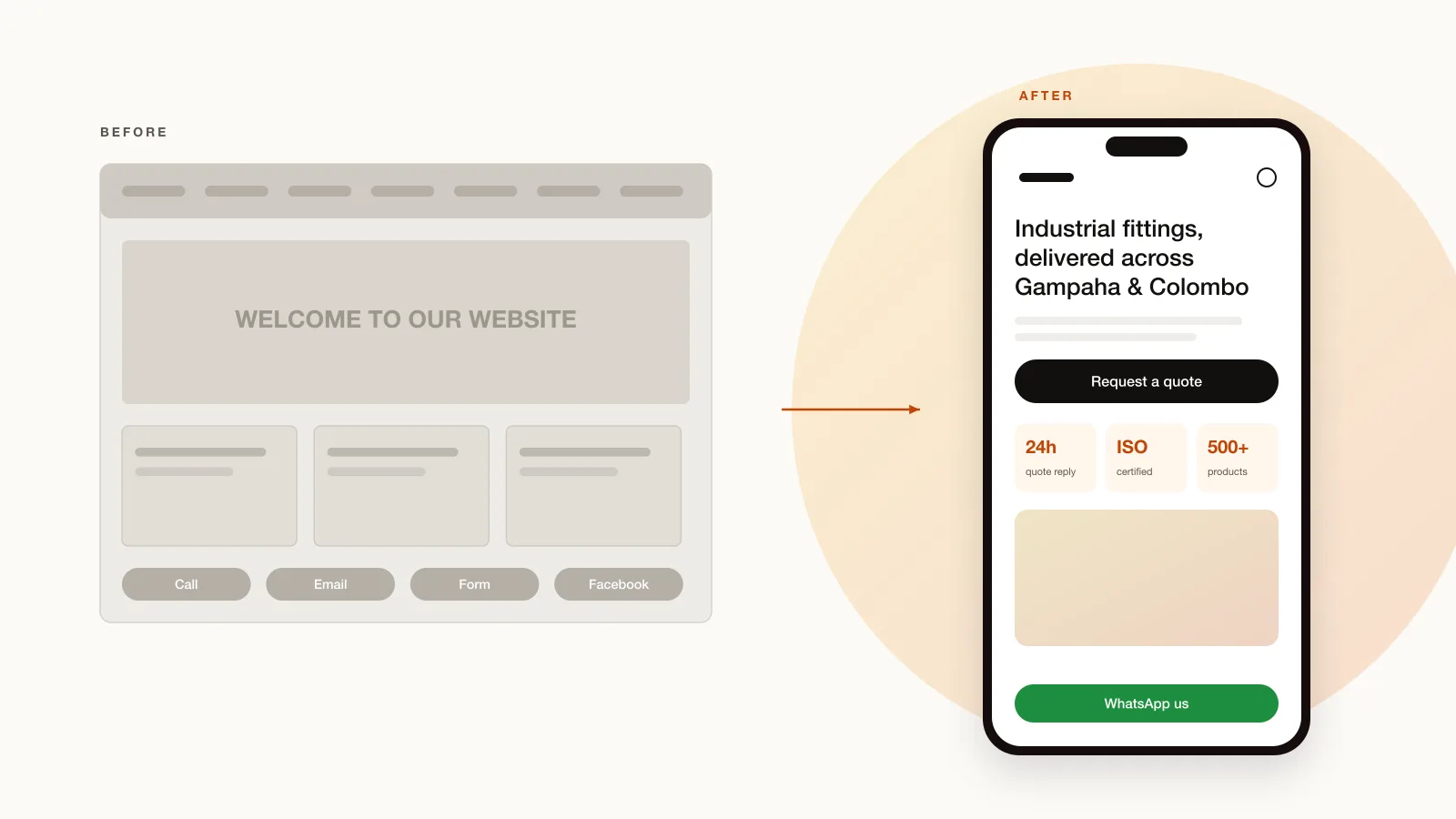
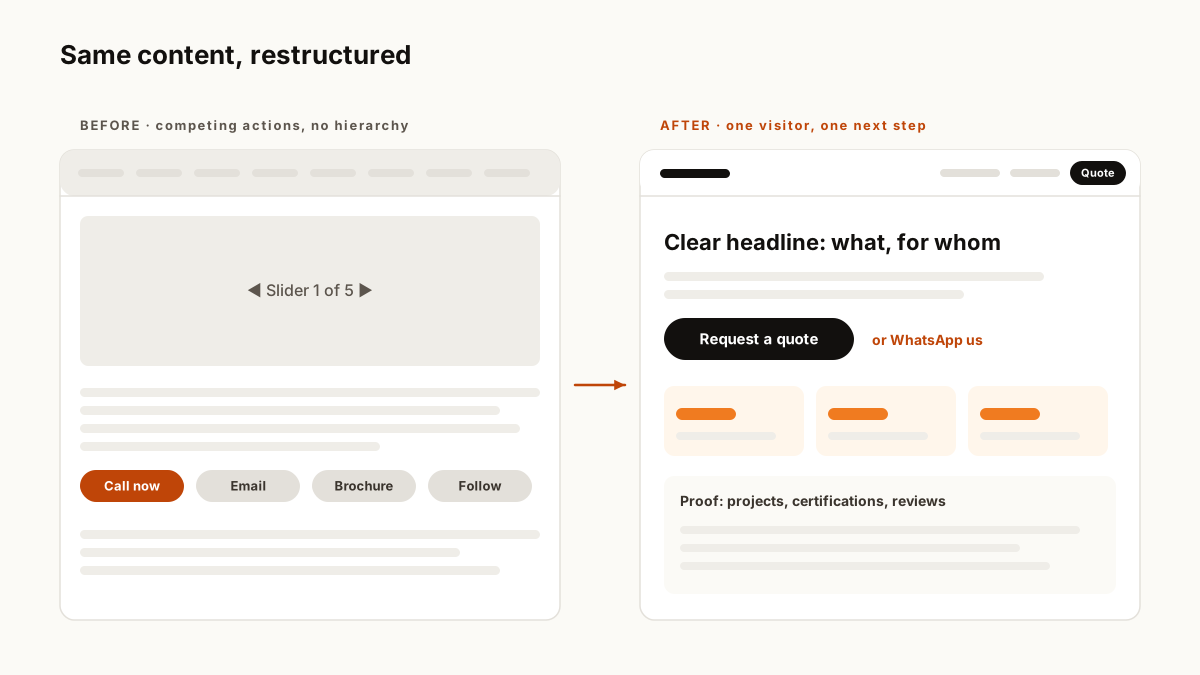
Look at your homepage and ask: what exactly should a visitor do next? If the answer is "call us, email us, fill in the form, follow us on Facebook, or read our history", the real answer is nothing. Every important page needs one primary action suited to its visitor, such as request a quote, book a consultation, check availability or message on WhatsApp.
What fixing it involves: mapping each page to a visitor intent and a single primary action, then designing so that action is obvious without being pushy. Our conversion rate optimisation guide covers the method.
5. Navigation is difficult
If customers regularly phone to ask things your website already answers, they probably couldn't find the answer. Menus organised around your internal departments rather than customer questions, ten top-level items, and important pages buried three clicks deep are all signs of weak information architecture.
What fixing it involves: card sorting or simple customer interviews, a new site map built around what people come to do, and clear labels in customers' own words.
6. Trust signals are weak
A visitor who doesn't know you needs evidence. Weak sites rely on adjectives like "leading", "quality" and "trusted". Strong sites show proof: named team members, real premises, client logos you have permission to use, case studies, certifications, reviews, clear addresses and business registration details where relevant.
What fixing it involves: gathering proof you already have but don't show, and designing it into the pages where people make decisions, not just onto an "About" page.
7. You're hard to find on Google
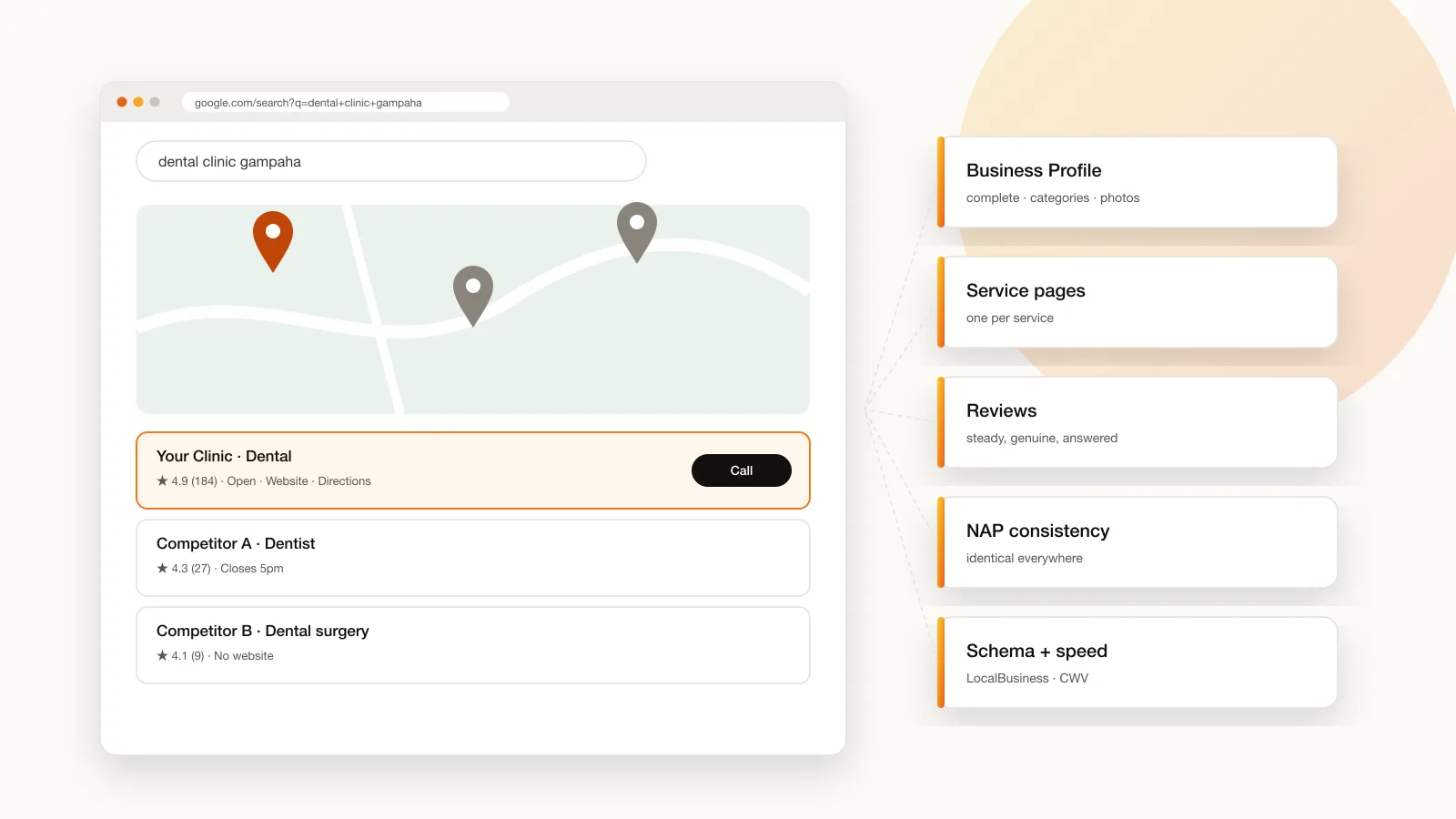
If you don't appear when someone nearby searches for what you do, the website is probably part of the problem. Typical causes include missing page titles, one page trying to rank for everything, no location or service pages, no structured data, thin content, or a site Google can't crawl properly.
What fixing it involves: a technical SEO audit, a page structure that gives each service its own properly targeted page, and alignment with your Google Business Profile. Our SEO services cover this, and our article on local SEO and web design in Gampaha explains how the website and the Business Profile work together.
8. The content is outdated
Services you no longer offer, a team page showing people who've left, prices from two years ago, a "latest news" item from 2021. Outdated content erodes trust and creates awkward conversations. It usually happens because the site is too hard to update, so nobody does.
What fixing it involves: a content audit (keep, rewrite, merge or remove each page), new copy where needed, and a CMS your team can actually use.
9. There's no analytics or conversion tracking
If you can't answer "how many enquiries did the website produce last month, and from which pages?", you're making decisions blind. Many older sites have analytics installed but nothing configured to count form submissions, calls, WhatsApp clicks or quote requests.
What fixing it involves: setting up analytics and reporting with defined conversion events, connecting Google Search Console, and a simple monthly view that shows what's working.
10. The website doesn't generate enquiries
This is the sign that matters most, and it's usually the result of several signs above combined. A business website exists to create conversations with the right people. If yours doesn't, or you can't tell whether it does, that's the strongest case for a redesign.
Refresh, rebuild or replatform?
Once you've scored your site, the answer usually falls into one of three categories.
| Situation | Usually means | Typical work |
|---|---|---|
| Sound platform, dated look, reasonable speed | Refresh | Visual redesign, content update, CTA and trust improvements |
| Confusing structure, weak content, poor conversion | Rebuild | New information architecture, UX, copy and design, often on the same CMS |
| Slow, insecure, hard to edit, can't support needed features | Replatform | New technical foundation (for example, a modern WordPress build or a custom stack) plus rebuild |
Choosing between platforms is a separate decision. Our comparison of Next.js and WordPress for Sri Lankan businesses covers the trade-offs.
What a proper redesign includes
A redesign that changes results usually covers most of the following:
- UX research: analytics, heatmaps or session recordings where available, and short conversations with customers and sales staff.
- Information architecture: a site map built around customer tasks.
- Content strategy: what each page must say, in what order, with what proof.
- Mobile-first UI design: designed for the phone first, then adapted to larger screens.
- Accessibility: readable contrast, keyboard access, meaningful alt text and form labels, following WCAG 2.2 where practical.
- Technical SEO: clean URLs, titles and descriptions, heading structure, canonical tags, XML sitemap, and structured data for your organisation, services and breadcrumbs.
- Performance: Core Web Vitals targets built into the design, not patched afterwards.
- Conversion optimisation: clear primary actions, short forms, WhatsApp and click-to-call where your customers prefer them.
- A usable CMS: your team can update content without a developer.
- Analytics: conversion events defined before launch, not after.
The UI/UX design process guide walks through how these stages fit together.
How to redesign without losing your Google rankings
The biggest risk in a redesign is losing search visibility you already earned. It happens when URLs change without redirects, pages that ranked are deleted or thinned out, or the new site launches with indexing blocked by mistake.
The safeguards are straightforward:
- Crawl and export every existing URL before work starts.
- Identify pages that receive search traffic or links in Search Console.
- Map each old URL to its new equivalent and implement 301 redirects, as Google's guidance on site moves with URL changes recommends.
- Keep or improve the content on pages that already rank.
- Check robots settings, canonical tags and the XML sitemap on launch day.
- Monitor Search Console for crawl errors and ranking changes for several weeks.
Our 25-point website redesign checklist covers the full pre-launch process.
What this looks like in practice
Our work for St Luke's Medical Laboratory, a diagnostic lab based in nearby Ja-Ela, was a complete rebuild rather than a reskin. The lab's services, pricing and home-collection coverage weren't easy to find online. The new site was restructured around how patients actually search: one page per test category, a transparent pricing module, a home-collection booking flow, and service-area pages for the suburbs it covers, including Kandana, Welisara, Ragama and Wattala. All of it sits on a local SEO foundation with LocalBusiness and MedicalClinic structured data.
The lesson for any Kandana business applies well beyond healthcare. The visual design mattered, but the structural decisions did most of the work: which pages exist, what each one answers and where the next step sits.
Where to start
Go through the ten signs with your own site open on your phone. Note which ones apply, and ask your team which questions customers keep asking that the website should have answered. That list is a better starting brief than any design reference.
If you're weighing up the budget side, our guide to what a business website costs in Ja-Ela explains the cost drivers, and they apply equally to redesigns. If your customers are other businesses, what a modern B2B website should do covers the content that builds buyer confidence. For the local search side specifically, see why smaller towns like Kandana and Ragama can outrank bigger competitors.
Uniix Studio is a Colombo-based creative digital agency working with businesses across Kandana, Ragama, Ja-Ela, Wattala and the wider Gampaha district on website redesign, UI/UX design, web development and SEO.
Frequently asked questions
How long does a website redesign take?
A focused redesign of a small business site typically takes four to eight weeks. Larger sites with new information architecture, a CMS migration or integrations take eight to sixteen weeks. Content, meaning rewriting pages and gathering photography, is usually the longest part, so starting it early shortens the whole project.
Will redesigning my website hurt my Google rankings?
It can if URLs change without redirects, pages are removed, or content is thinned out. A careful redesign maps every old URL to its new equivalent with 301 redirects, keeps or improves the content on pages that rank, and is checked in Search Console after launch. Done that way, a redesign usually protects existing visibility and often improves it.
Should I redesign my website or build a new one from scratch?
If the platform is sound and the problems are visual or content-related, a redesign on the existing CMS may be enough. If the site is slow because of its technical foundation, hard to edit, insecure, or can't support features you need, a rebuild is usually cheaper over time. An audit should make the recommendation, not habit.
How much does a website redesign cost in Sri Lanka?
A redesign costs roughly what a new build of the same scope costs, because most of the work is the same: UX, design, content and development. You may save on content you can reuse and on decisions already made. See our Sri Lankan website cost breakdown for typical 2026 ranges by project type.
How often should a business website be redesigned?
There's no fixed cycle. Many businesses find a significant redesign useful every three to five years, with continuous small improvements in between. The better trigger is evidence: falling enquiries, poor mobile performance, outdated content, or a business that has changed more than its website has.
Can I keep my domain name and existing content in a redesign?
Yes. You should keep your domain, since it carries your search history and brand recognition. Good existing content can be kept and improved. Pages that rank well should keep their URLs where possible, or be redirected carefully if the structure changes.
Do you work with businesses in Kandana and Ragama?
Yes. Uniix Studio is based in Colombo and works with businesses across the Gampaha district, including Kandana, Ragama, Ja-Ela and Wattala. Audits, workshops and reviews run over calls and shared links, and we meet in person when it helps the project.
Related services
Where Uniix Studio can help
UI/UX Design
User-centred design for web and mobile that turns visitors into customers.
Web Design
Fast, brand-led, conversion-focused websites built on modern stacks.
Web Development
Next.js, WordPress, headless and bespoke builds.
SEO Services
Technical SEO, content clusters, local SEO, AEO and GEO for 2026.
Next step
Already have a website that's underperforming?
Send us the URL. We'll review the UX, content and technical foundation, then tell you plainly whether it needs a refresh, a rebuild or neither.