Web Design for Wattala Businesses: What a Modern B2B Website Should Actually Do
A B2B website isn't an online brochure. For Wattala's distributors, manufacturers, logistics firms and service companies, it should establish credibility, answer buyer questions, support the sales team and turn the right visitors into qualified enquiries.
Uniix Studio
Creative Digital Agency
In brief
- B2B buyers research before they contact you. The website has to answer their questions and prove you're a safe choice.
- The strongest B2B sites work as sales tools: spec sheets, industry pages and case studies your team can send to prospects.
- Measure qualified enquiries, not visits. Route each one to the right person by form, email, WhatsApp or CRM.
Contents
- 01What should a modern B2B website actually do?
- 02Why the brochure model fails B2B buyers
- 03Seven jobs a B2B website has to do
- 04What should be on a modern Wattala business website?
- 05Integrating WhatsApp, email and CRM, where it makes sense
- 06Mobile matters in B2B, too
- 07Technical foundations that support all of this
- 08How to know whether the website is working
- 09What this looks like in real projects
- 10Where to start
Many business websites in Wattala were built as online brochures: a homepage banner, an "About Us" page, a list of products and a contact form. They confirm the company exists. They rarely help it sell.
That model is especially weak for B2B businesses such as distributors, importers, manufacturers, logistics providers, industrial suppliers and professional service firms. Their buyers research carefully, involve more than one person, and want specific answers before they make contact. A brochure doesn't give them enough to act on.
This article explains what a modern B2B website should do for a Wattala business, what belongs on it, and how to judge whether it's working.
What should a modern B2B website actually do?
A modern B2B website should help buyers qualify you without a phone call. It should prove you're credible, explain your products and services in the buyer's terms, provide the specifications and documents they need, answer common pre-sales questions, rank for what they search, and turn serious interest into a qualified enquiry that reaches the right person quickly.
Put simply, it's a sales tool that works when your sales team isn't in the room.
Why the brochure model fails B2B buyers
A brochure website is organised around what the company wants to say. A B2B buyer arrives with a job to do: find a supplier for a specific need, check that supplier is legitimate, and justify the choice to someone else.
That buyer might be a procurement officer comparing three distributors, an engineer checking whether a component meets a specification, a Colombo retailer looking for a reliable local importer, or a finance manager verifying a new vendor. Each needs something different, and none of them is well served by a paragraph about "commitment to quality since 1998".
Wattala's position matters here. The town borders Colombo's northern edge, sits on the route to Negombo and the airport, and is close to the Kelani crossing at Peliyagoda and to commercial areas such as Mabole and Hunupitiya. Many Wattala businesses sell into Colombo and beyond, so their buyers are comparing them directly with Colombo-based suppliers. The website is often where that comparison happens.
Seven jobs a B2B website has to do
1. Establish credibility quickly
Buyers look for signals that a supplier is real, established and low-risk. The most persuasive signals are specific:
- Registered company name, address and years in operation.
- Photographs of your actual premises, warehouse, fleet or team.
- Certifications with the issuing body named (ISO, product approvals, industry memberships).
- Brands you distribute or partners you work with, shown with permission.
- Named clients, project references or case studies.
Generic claims such as "leading", "trusted" and "world-class" don't count as evidence. Remove them or back them up.
2. Explain products and services in the buyer's language
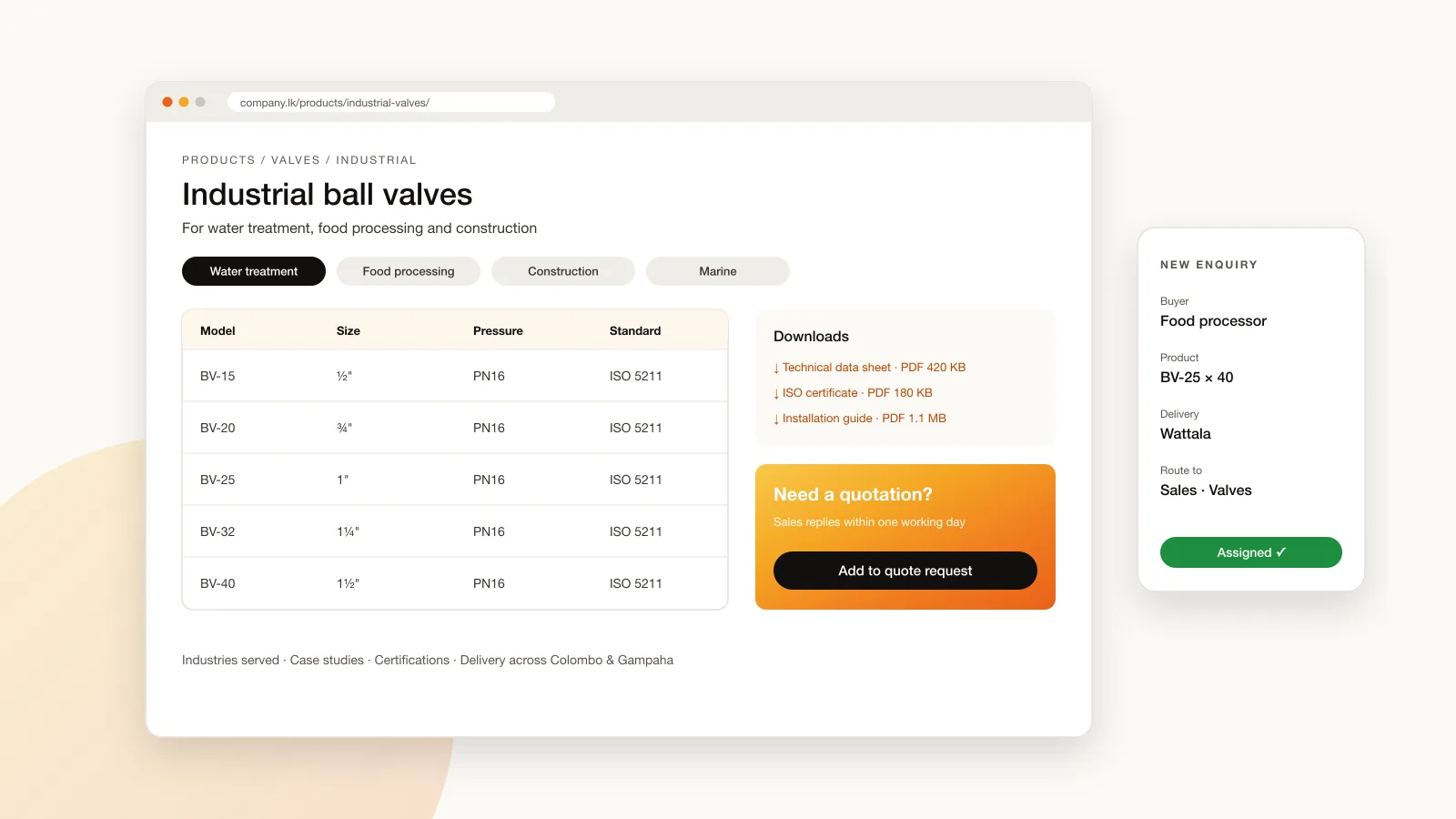
Organise information around how buyers think, not how your departments are structured. An industrial supplier might organise by application ("for food processing", "for construction") as well as by product type. A logistics firm might organise by shipment type and route rather than by internal division.
Each product or service needs its own page with specific detail: what it is, who it's for, specifications, standards, available sizes or options, lead times and minimum order quantities where relevant.
3. Present catalogues buyers can actually use
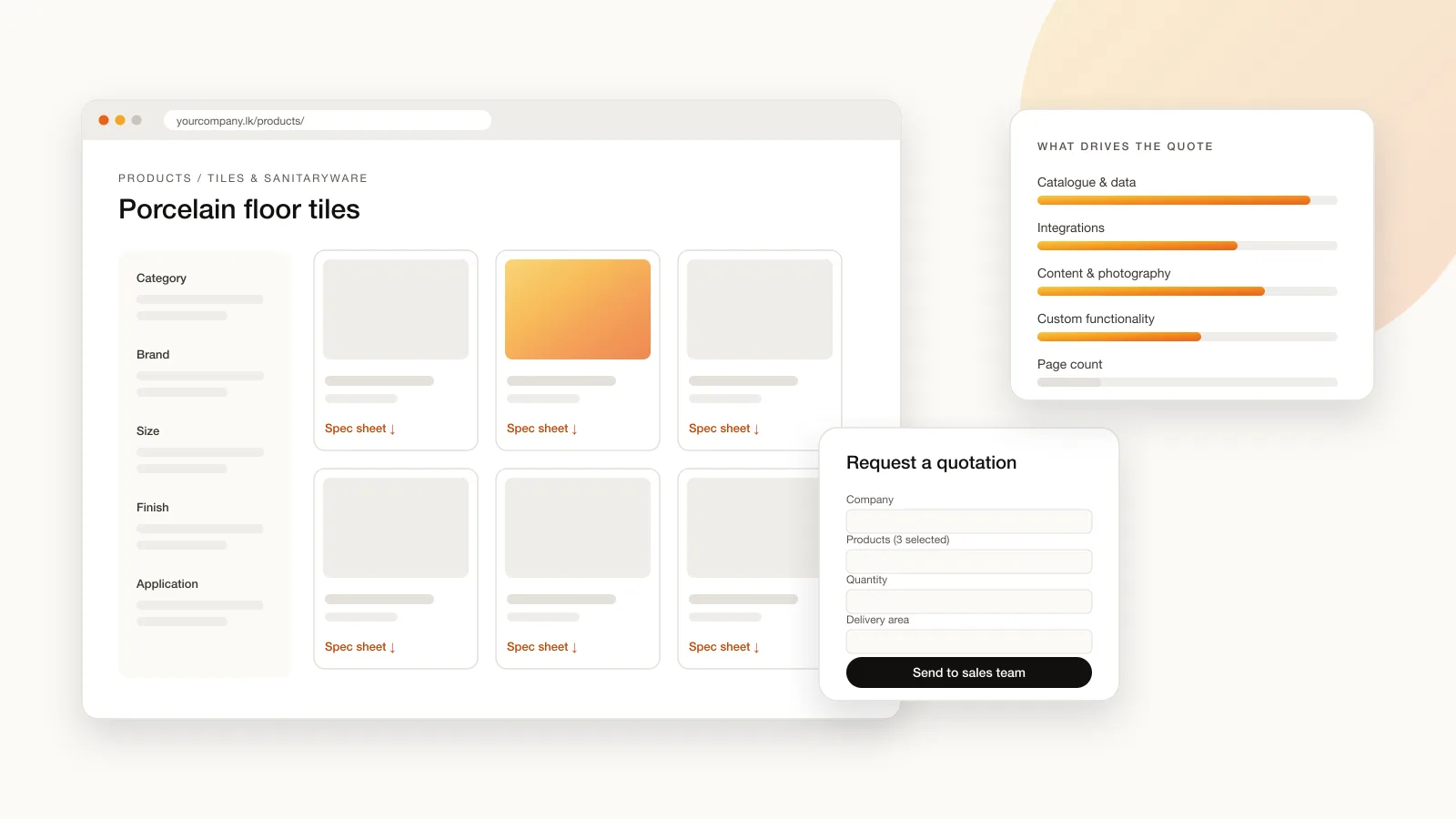
For distributors and manufacturers, the catalogue is the core of the site. A useful online catalogue has:
- Categories and filters that match how buyers search (application, material, size, brand).
- A consistent product template with specifications in a scannable table.
- Downloadable data sheets, certificates and installation guides.
- A way to add items to a quote request rather than calling about each one.
A 60-page PDF catalogue on its own isn't enough. It's hard to read on a phone, it can't be filtered, and individual products don't rank on Google. Offer the PDF as a download alongside searchable product pages.
4. Support the sales team
The best B2B websites are used by the sales team every day. Sales staff send links to specific product pages, case studies and spec sheets instead of attaching files. They use the FAQ page to answer routine questions. New staff learn the product range from the site.
When we plan a B2B site, we ask the sales team what they explain repeatedly, what documents they send most, and what questions come before an order. Those answers become pages.
5. Capture qualified enquiries
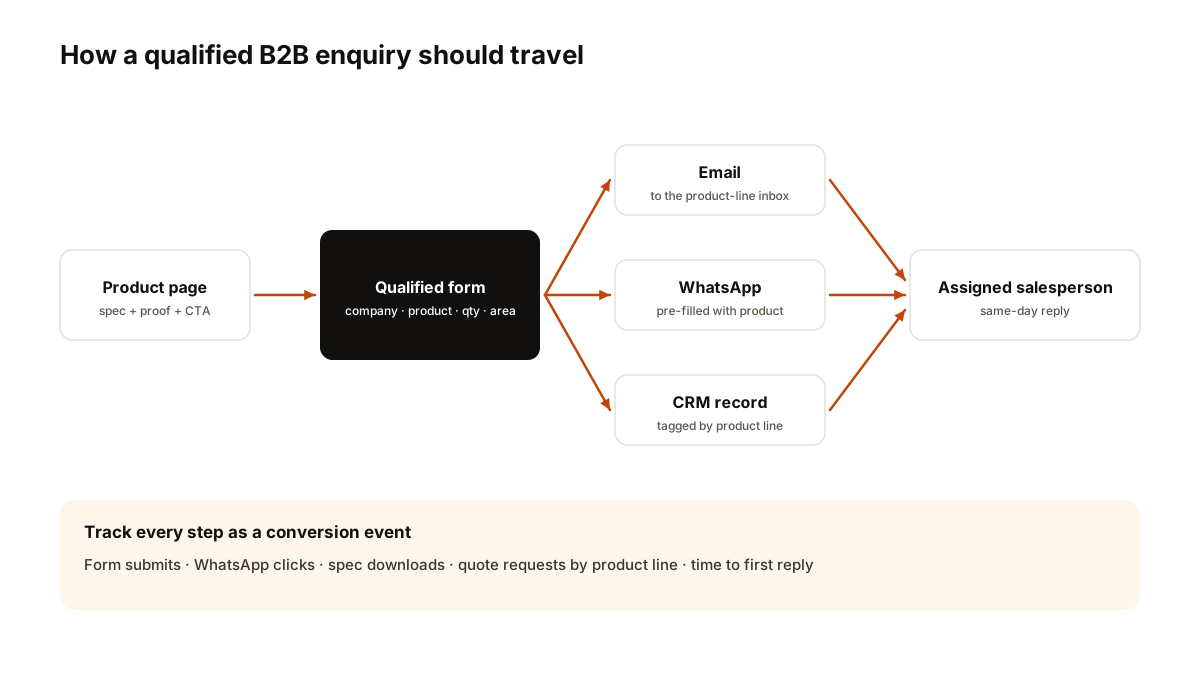
A contact form that asks only for "name, email, message" produces vague enquiries that take several emails to understand. A B2B enquiry form should capture enough to qualify and route the lead:
- Company name and the buyer's role.
- Product or service of interest (pre-filled from the page they came from).
- Quantity, frequency or project size.
- Delivery location and timeline.
- Preferred contact method.
Keep it short enough that serious buyers complete it. Four to six well-chosen fields usually beat twelve.
6. Answer buyer questions before they ask
Put the answers to common pre-sales questions on the site: delivery coverage across Colombo and Gampaha, lead times, credit terms, minimum orders, warranties, returns, and the documents you can provide. Answering these publicly saves your team time, qualifies buyers before they contact you, and gives search engines and AI assistants clear information to understand and cite.
7. Rank for what buyers search
B2B search terms are specific and often low in volume but high in intent: a product name with a specification, "supplier Sri Lanka", "distributor Colombo", or an application-based query. A site that gives each product line, service and industry its own well-structured page has a real chance of ranking for those terms. A single "Products" page listing everything does not. Our SEO services build this structure into the site from the start.
What should be on a modern Wattala business website?
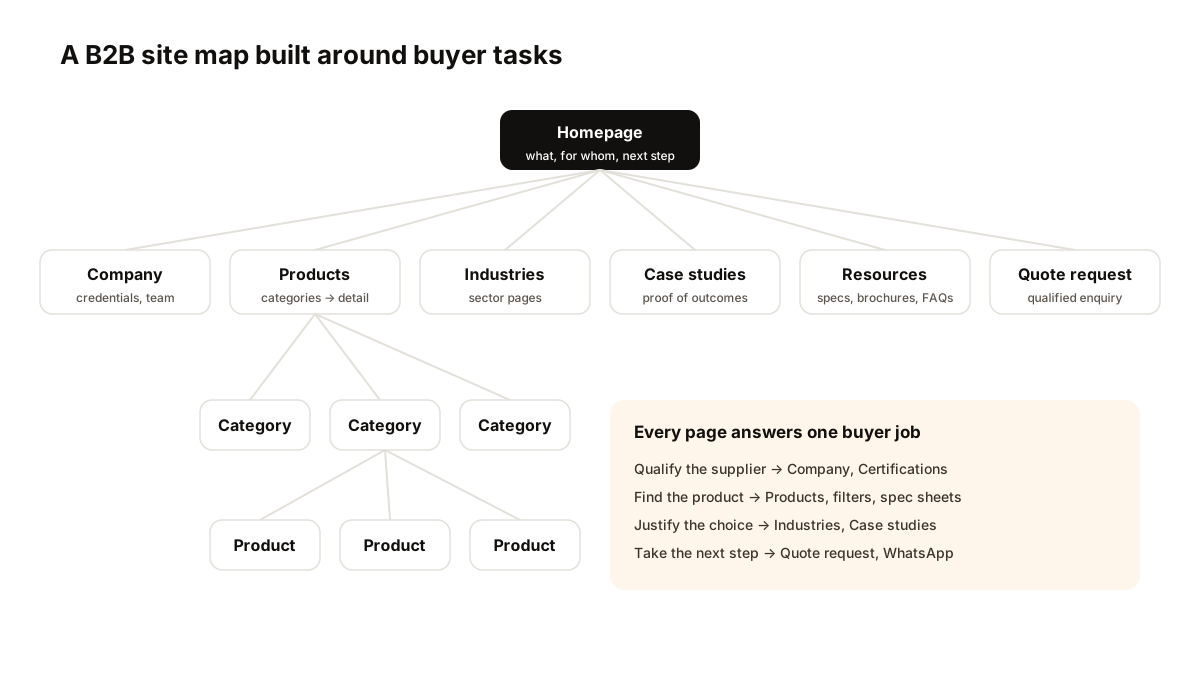
Here's a practical checklist for a Wattala B2B or corporate website. Not every business needs every item, but each should be a deliberate decision.
| Element | Why it matters | Common mistake |
|---|---|---|
| Strong homepage | States what you do, for whom, and the next step within one screen | A rotating slider with vague slogans |
| Company credibility | Proves you're established and low-risk | "About Us" with no specifics |
| Products / services | Lets buyers find exact offerings | One page listing everything |
| Industries served | Helps buyers see you understand their sector | Missing entirely |
| Case studies | Shows real outcomes and experience | Logos only, no substance |
| Certifications | Supports procurement and compliance checks | Badges without issuer or scope |
| Downloadable resources | Spec sheets and brochures buyers can forward | PDFs as the only product information |
| FAQs | Answers pre-sales questions and supports search | Generic questions nobody asks |
| Contact / enquiry system | Captures qualified leads and routes them | One generic form to one inbox |
| Google Maps and location | Confirms a real address and helps visits and deliveries | Map embed with no address text |
| Technical SEO | Lets search engines crawl and understand every page | No titles, duplicate content, no sitemap |
| Analytics | Shows which pages and sources produce enquiries | Visits tracked, enquiries not |
Integrating WhatsApp, email and CRM, where it makes sense
In Sri Lanka, many B2B conversations move to WhatsApp quickly, and that's fine. It's often where buyers are most responsive. The website should make that hand-off smooth: a WhatsApp button that opens a chat with the product name and page already filled in, routed to the right salesperson rather than a general number nobody watches.
For businesses with higher lead volumes, form submissions can create records in a CRM automatically, tag them by product line and assign them to the right person. Smaller teams may just need structured email notifications that go to the correct department. The right level depends on your process. Automation added before there's a process to support it rarely helps.
If you collect personal data through the website, handle it responsibly. Explain what you collect and why in a clear privacy notice, collect only what you need, and consider your obligations under Sri Lanka's Personal Data Protection Act.
Mobile matters in B2B, too
It's easy to assume B2B buyers browse at a desk. Many don't. A contractor checks specs on site, a procurement manager reviews a shortlist between meetings, and a business owner looks you up after a WhatsApp introduction. Specification tables need to work on a phone, downloads need clear file sizes, and the quote button must be easy to reach.
Technical foundations that support all of this
The visible design sits on technical choices that affect speed, search visibility and maintainability:
- A CMS your team can use to add products, update specs and publish case studies. For many companies that's a well-built WordPress site. For complex catalogues or integrations, custom web development may be more practical.
- Structured data for your organisation, products where appropriate, and breadcrumbs, so search engines understand the site's entities.
- Performance within Google's Core Web Vitals targets, which means optimised images and lean templates, especially on catalogue pages.
- Clean URLs and internal linking between related products, industries and case studies.
- Search Console and analytics configured with enquiry events from day one.
How to know whether the website is working
Traffic alone says little about a B2B website. Better measures include:
- Qualified enquiries per month, and which pages they came from.
- Quote requests by product line.
- Spec sheet and brochure downloads.
- Search impressions and clicks for product and service terms in Search Console.
- How often the sales team uses and shares website links.
- Time from first enquiry to quotation.
These tell you whether the website is supporting sales, and where to improve it.
What this looks like in real projects
Two projects in our portfolio show the principle at different scales. For the Coventry Business Club, a UK business network, we redesigned the corporate WordPress site around what members and prospective members needed to do: browse events, use the members directory, and apply for membership through a clear application funnel. For St Luke's Medical Laboratory in Ja-Ela, part of the site serves a professional audience, with a partner programme and resources for referring doctors alongside the patient-facing pages.
Different sectors, same idea. Each audience gets a clear path to the information and action that matters to them.
Where to start
List the five questions your sales team answers most often, the three documents they send most, and the types of buyer who contact you. That's the foundation of a B2B website brief.
If budget is the next question, our guide to what a business website costs in Ja-Ela explains how catalogue size, integrations and content affect the number. The B2B content marketing strategy guide covers what to publish after launch. If your current site already has most of this but isn't performing, the ten signs a website needs a redesign will help you diagnose why.
Uniix Studio is a Colombo-based creative digital agency that designs and develops B2B and corporate websites for companies in Wattala, Peliyagoda, Ja-Ela and across Colombo and the Gampaha district. You can also see our Wattala web design page.
Frequently asked questions
Does a Wattala business need a corporate website?
If you sell to other businesses, yes. Buyers, procurement teams, partners and lenders usually check a supplier online before engaging, and a credible website with clear products, proof and contact routes answers their first questions. A social media page alone rarely gives a B2B buyer enough information to shortlist you.
What pages should a B2B website have?
At minimum: a clear homepage, company and credentials, products or services with detail pages, industries served, case studies or project references, certifications, downloadable resources, FAQs, and a contact or quote request page with location details. Larger companies add careers, news and partner or distributor pages.
Should a B2B website show prices?
Show prices where they're stable and help buyers qualify themselves, such as standard products or service packages. Where pricing depends on volume, specification or contract terms, explain what affects the price and make the quote request easy. Either way, be clear about minimum orders, lead times and delivery coverage.
Should product catalogues be PDFs or web pages?
Both, for different jobs. Web pages are searchable, easier to read on a phone and can be indexed by Google. PDFs and spec sheets are useful as downloads that buyers can forward internally. The web page should come first, with the PDF offered alongside it.
Can a website connect to our CRM or WhatsApp?
Yes. Enquiry forms can create records in most common CRMs, send structured emails to the right department, and hand off to WhatsApp Business with the product and details pre-filled. What's appropriate depends on your sales process, the volume of leads and how you handle customer data.
How does a B2B website generate leads?
By ranking for the specific products, services and problems buyers search for, answering their questions clearly, proving capability with case studies and credentials, and making it easy to request a quote or speak to someone. Lead volume depends on market demand and search visibility, so no honest provider can guarantee a number.
Is Uniix Studio based in Wattala?
No. Uniix Studio is based in Colombo and works with businesses in Wattala and across the Gampaha district. Workshops and reviews run over calls and shared links, and we meet in person when a project benefits from it.
Related services
Where Uniix Studio can help
Web Development
Next.js, WordPress, headless and bespoke builds.
Web Design
Fast, brand-led, conversion-focused websites built on modern stacks.
UI/UX Design
User-centred design for web and mobile that turns visitors into customers.
SEO Services
Technical SEO, content clusters, local SEO, AEO and GEO for 2026.
Next step
Need a website that supports your sales team?
Tell us who your buyers are, what they ask before they order and where enquiries go today. We'll show you how the site should be structured to qualify leads and shorten the sales conversation.