How Much Does a Business Website Cost in Ja-Ela? A Practical 2026 Guide
Two quotes for “a website” can be five times apart and both be honest. This guide explains what Ja-Ela manufacturers, importers, showrooms and service firms are actually paying for, and the questions to ask before you sign.
Uniix Studio
Creative Digital Agency
In brief
- Location doesn't change the rate. Scope does. A Ja-Ela site costs the same to build as a Colombo site with the same brief.
- Most Ja-Ela trade businesses need a catalogue or corporate site, not e-commerce. That decision moves the budget more than anything else.
- Budget for ownership as well as the build: hosting, maintenance, content and search work all recur.
Contents
- 01How much does a business website cost in Ja-Ela?
- 02Why the location doesn't change the price, but the business model does
- 03The five types of business website, and who needs each
- 04What actually drives a website quote?
- 05Build cost versus cost of ownership
- 06How agencies price website projects
- 07Questions to ask before you accept a quote
- 08Red flags in a cheap quote
- 09An illustrative example: a Ja-Ela building-supplies distributor
- 10Where to start
A business website in Ja-Ela costs the same to build as one in Colombo with the same brief. That's the short answer. The more useful answer is that most of the spread between quotes comes from five decisions: what kind of site you need, how big your catalogue is, what it has to connect to, who produces the content, and what happens after launch.
This guide is written for the businesses that make up much of Ja-Ela's commercial base: manufacturers around the Ekala industrial estate, exporters and suppliers near the Katunayake zone, importers and distributors along the A3, showrooms, construction suppliers and professional firms. It explains the project types, the cost drivers, the running costs nobody mentions, and the questions that will tell you whether a quote is honest.
How much does a business website cost in Ja-Ela?
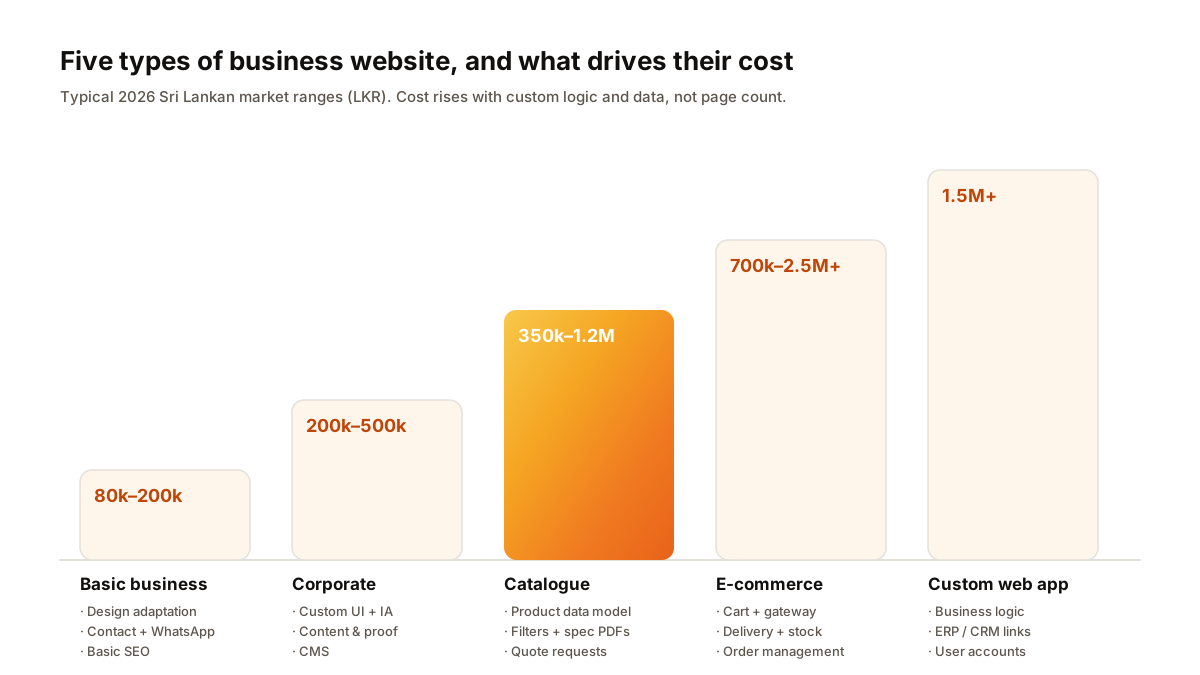
In 2026, typical Sri Lankan market ranges run from about LKR 80,000 for a small brochure site to LKR 500,000–1,200,000 for an advanced catalogue or portal, with e-commerce starting around LKR 700,000. A Ja-Ela address doesn't change the rate. Catalogue size, integrations, content production and custom functionality do.
The ranges below match the bands in our full breakdown of website costs in Sri Lanka. They're market ranges for quality work, not a price list:
| Project type | Typical 2026 range (LKR) | Common Ja-Ela fit |
|---|---|---|
| Basic business website (1–5 pages) | 80,000 – 200,000 | Sole traders, new service firms, single-branch businesses |
| Professional corporate website (5–15 pages) | 200,000 – 500,000 | Established SMEs, professional services, contractors |
| Catalogue / product website | 350,000 – 1,200,000 | Manufacturers, importers, distributors, building suppliers |
| E-commerce website | 700,000 – 2,500,000+ | Retailers and brands selling at fixed prices online |
| Custom web application | 1,500,000+ | Dealer portals, quotation tools, inventory-linked systems |
The catalogue band is wide because "catalogue" can mean forty products with a PDF each, or four thousand SKUs synced from an ERP. That difference is scope, not pricing games.
Why the location doesn't change the price, but the business model does
It's reasonable to expect a Gampaha-district business to pay less than a Colombo 3 firm. In practice, the people who design, write and build websites charge for their time and skills, and a well-run project happens over calls, WhatsApp and shared prototypes wherever the client is. We're a Colombo-based studio, and our Ja-Ela web design work runs the same way as any other project.
What does differ in Ja-Ela is the kind of business, and so the kind of website. A lot of the town's commerce is B2B: a buyer at a garment exporter checking a packaging supplier, a contractor looking for a steel or tiles distributor, a bank officer verifying a borrower, a foreign partner doing due diligence. Those visitors aren't impressed by animation. They want proof that you're real, clear product information, and a fast way to reach the right person.
That's why the most common mistake we see is a business paying e-commerce prices for a site that only needed a strong catalogue and enquiry flow. The opposite happens too: a distributor with a thousand products buys a five-page brochure site and ends up emailing PDFs forever.
The five types of business website, and who needs each
1. Basic business website
A small, well-designed site: home, about, services, contact, maybe a gallery. The job is credibility and contact. It suits a new consultancy, a small contractor or a single-location service business in Ja-Ela town that mostly needs to be findable and look trustworthy when someone checks them out.
What you're paying for: a clean design (often adapted from a framework rather than fully bespoke), mobile layouts, a contact form and WhatsApp button, Google Business Profile alignment and basic on-page SEO. What usually isn't included: copywriting, photography and ongoing content.
2. Professional corporate website
Five to fifteen pages, custom design, a CMS, and more than one audience: customers, suppliers, lenders, sometimes recruits. For an established Ja-Ela manufacturer or a professional firm, this site carries the company story, capabilities, certifications, industries served, project references and news.
The extra cost goes into information architecture (deciding what goes where and why), custom UI design, stronger content, and the details that build trust. That means named people, real facility photography, certificates you can verify, and a clear route to the sales desk.
3. Catalogue or product website
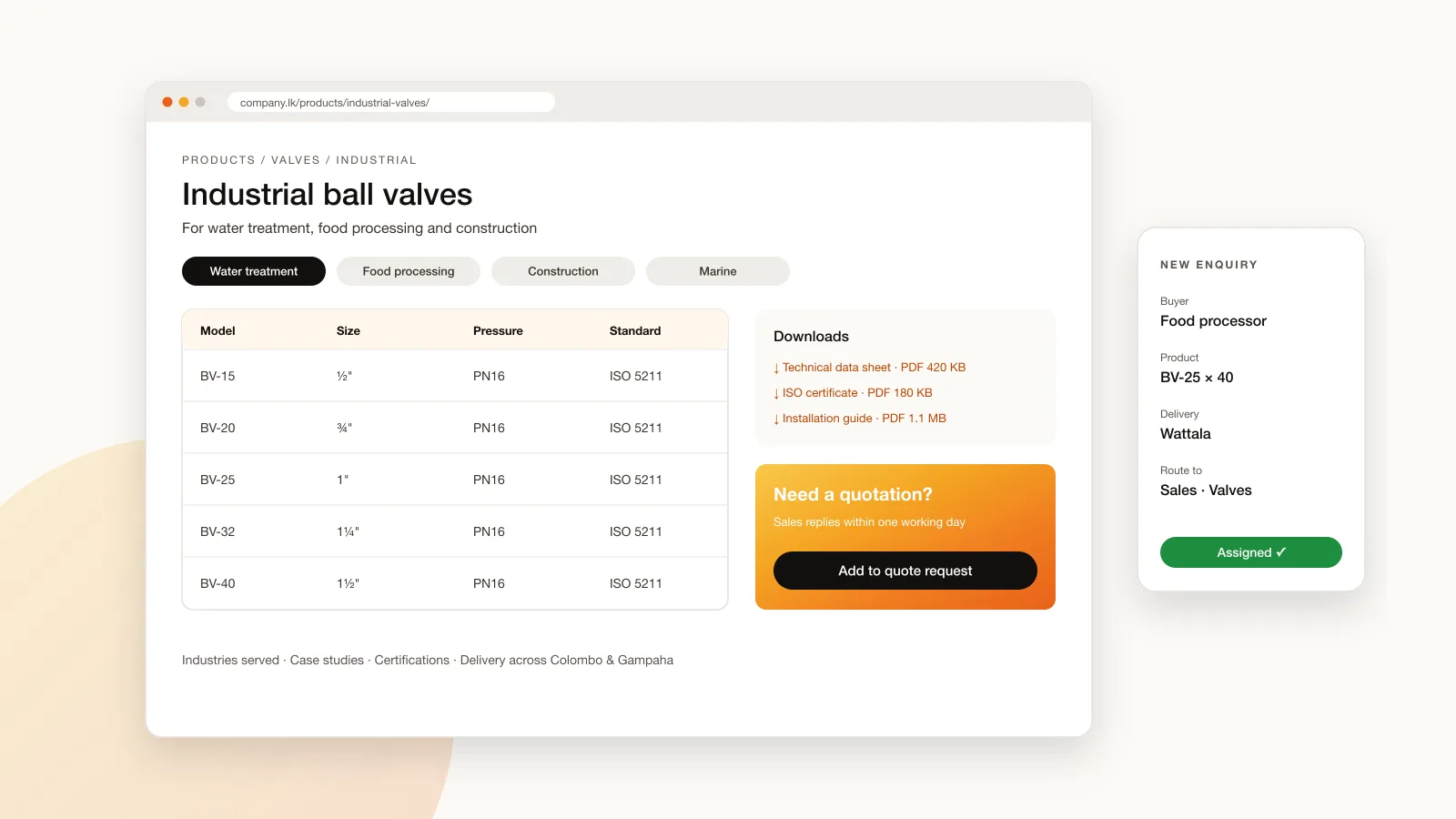
This is the most common need in Ja-Ela and the most under-scoped. A catalogue site lets buyers browse categories, filter products, read specifications, download data sheets and send a quotation request for specific items. There's no cart and no online payment.
What drives the price is the product data model (what attributes each product has), filtering, the number of templates, bulk import of existing product data, and how your team will keep it current. A distributor with 60 products and one with 3,000 products synced from an inventory system are in different budget bands, even if the designs look similar.
4. E-commerce website
A full online store with cart, checkout, payment gateway, delivery rules, order management and customer accounts. For Ja-Ela, this fits retailers, consumer brands and showrooms that sell at a fixed price and want to reach buyers beyond the drive-in radius, across Gampaha and Colombo.
Budget drivers include the platform (WooCommerce or Shopify), the payment gateway (a local option such as PayHere or a bank-provided internet payment gateway, plus international cards if you sell abroad), delivery zones and courier integration, product volume and variants, and stock sync. Our e-commerce development page covers the platform choices in more depth.
5. Custom web application
When the website has to do something specific to your operation, you're building software rather than a site. Examples: a dealer portal with tiered pricing, a quotation generator that calculates material quantities, a stock-availability checker tied to your ERP, or a customer area that shows order history. These are scoped by function and usually built in phases, through custom web development rather than a page-based quote.
What actually drives a website quote?
Page count is the least useful way to compare quotes. These are the factors that move the number, roughly in order of impact for a Ja-Ela business.
Scope and structure
- Number of unique templates, not pages. Fifty product pages built from one template cost far less than fifty individually designed pages.
- UI/UX design depth. Adapting a proven layout is quicker than UI/UX design from research and wireframes up. The second is worth paying for when conversion matters or the audience is complex.
- Information architecture. Working out how buyers look for products (by application, material, size or brand) is design work that pays for itself in fewer "do you have…" phone calls.
Platform and build
- CMS choice. WordPress development keeps editing in-house and suits most corporate and catalogue sites. A custom build (for example, Next.js) costs more upfront but can make sense for performance-critical or integration-heavy projects. We compare the two in WordPress vs custom development.
- Custom functionality. Quote calculators, dealer logins, advanced filtering and multi-step forms are software, and they're priced that way.
Commerce and integrations
- Payment gateway. Setup, merchant approval and testing take time, and international cards add steps.
- Integrations. CRM, ERP, inventory, accounting, email marketing and WhatsApp Business routing. Each one needs specification, building and testing, and the cost depends on how clean the other system's API is.
Content
- Copywriting. Clear, specific writing that explains what you make and why buyers should trust you is often the difference between a site that sells and one that exists. It's frequently left out of cheap quotes.
- Photography and video. Real images of your facility, team and products outperform stock almost every time for B2B credibility. A half-day shoot is a line item in its own right.
- Product data preparation. Cleaning spreadsheets, writing specs and formatting data sheets is labour that someone has to do.
- Multilingual content. Sinhala and Tamil versions double or triple the content work and need a proper language structure, not machine translation pasted into one page.
Search and measurement
- SEO foundation. Technical setup, page titles, structured data, sitemap and Search Console are part of any competent build. Keyword research, content planning and local SEO are extra work, and our SEO services treat them that way.
- Analytics and conversion tracking. Knowing which pages generate enquiries takes deliberate setup of forms, calls and WhatsApp clicks as events.
Running costs
- Hosting. Anything from cheap shared hosting to managed cloud hosting. For a catalogue site with large images, performance depends heavily on hosting quality.
- Maintenance. Software updates, security, backups and small changes. We break these costs down in our website maintenance cost guide.
Build cost versus cost of ownership
A website isn't a one-off purchase. Over three years, running costs can add up to a large share of the build price, so compare total cost of ownership rather than launch price.
| Recurring item | What it covers | Who usually handles it |
|---|---|---|
| Domain renewal | Your .lk or .com address | You or the agency, on your account |
| Hosting | Server, bandwidth, SSL, uptime | Agency-managed or your provider |
| Maintenance | CMS and plugin updates, security patches, backups | Agency retainer or in-house |
| Content updates | New products, prices, news, case studies | Your team, if the CMS is well built |
| Search and content | Local SEO, articles, Google Business Profile | Agency or in-house marketer |
| Improvements | New features, landing pages, redesign of weak sections | Agency, as needed |
A useful planning rule: set aside around 20–30% of the build cost each year for the ownership layer on a site that's actively used for sales. A small brochure site can cost far less to run.
How agencies price website projects
Knowing the pricing model helps you read a quote.
- Fixed scope, fixed price. The most common model for business sites. The agency commits to a defined list of pages, templates, features and revisions. Changes outside that list are quoted separately. This works well when the brief is clear.
- Phased delivery. A first phase (for example, corporate site plus 100 priority products) launches quickly, and later phases add the full catalogue, integrations or portals. This is often the smartest route for a growing Ja-Ela distributor.
- Time and materials. Billed by effort. Suitable for custom applications where requirements will change, but it needs trust and regular reporting.
- Retainer. A monthly fee for continued development, content or SEO after launch.
Our guide to website timelines explains how scope and content readiness affect delivery dates under each model.
Questions to ask before you accept a quote
These questions separate an itemised, professional quote from a number someone guessed.
- What exactly is included? Ask for pages or templates, features, design rounds and integrations as a list.
- Who writes the content and supplies the images? If the answer is "you", the price is lower for a reason, and you need to plan the time.
- Which platform will you use, and why that one for my business?
- Will my team be able to add products and update prices without you? Ask for a demo of the editing screen.
- Who owns the domain, hosting account, design files and code? It should be you.
- What SEO is included at launch? Titles, descriptions, structured data, sitemap, redirects from any old site and Search Console setup should be standard.
- How are enquiries tracked? You should be able to see which pages produce form submissions, calls and WhatsApp messages.
- What happens after launch? Look for the warranty period, the maintenance options and the response time.
- How will the site perform on a mid-range Android phone on mobile data? Many of your buyers will check you on exactly that.
- Can I see comparable work, and speak to a client?
Our checklist of questions to ask a web development agency goes deeper on contracts and ownership.
Red flags in a cheap quote
A low price isn't automatically a problem, but these patterns usually mean costs have moved somewhere you can't see:
- A single number with no breakdown.
- "Unlimited pages" alongside a template you can't change.
- No mention of content, meaning you'll be writing everything at night.
- Hosting on the agency's account with no handover clause.
- "Guaranteed first page on Google." No honest provider can promise rankings.
- No redirect plan when replacing an existing website, which is how businesses lose years of search visibility overnight.
An illustrative example: a Ja-Ela building-supplies distributor
To make this concrete, here's how we would think through a hypothetical brief. It's not a real client and not a quote.
A distributor near the A3 carries around 400 products across tiles, sanitaryware and fittings. Contractors and hardware retailers buy on credit and in bulk, and prices are negotiated. The owner wants fewer "do you have this?" calls and more qualified quotation requests.
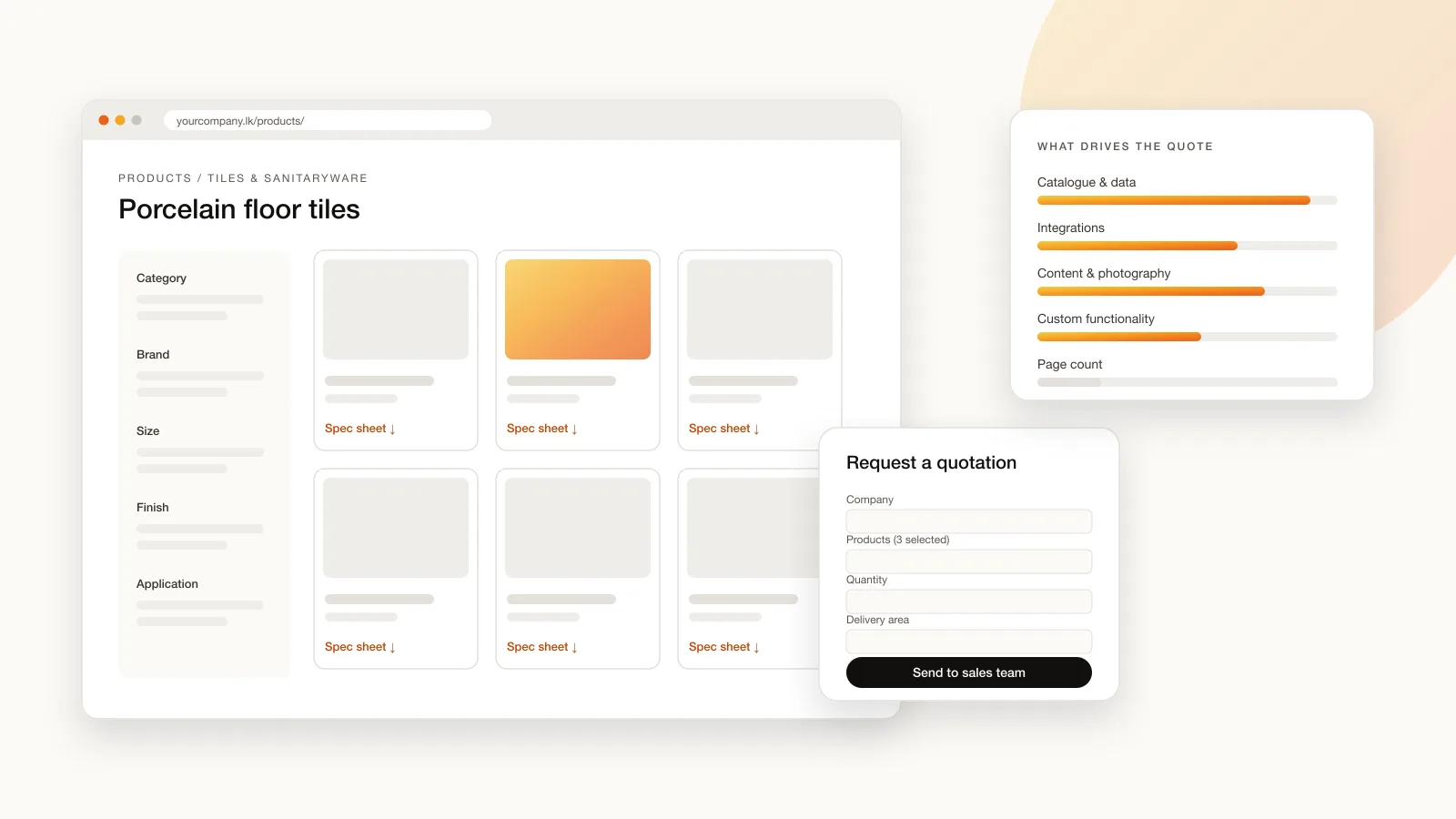
What the site needs: a corporate layer (company, brands carried, delivery coverage, credit terms, contact), a catalogue with filters by category, brand and size, a specification sheet per product, a "request a quote" basket that sends a structured enquiry to the sales team and WhatsApp, and a page for contractors explaining account opening.
What it doesn't need: a cart, online payment or customer accounts, at least not in the first phase.
Where the budget goes: catalogue architecture and filtering, product data clean-up and import, a quote-request flow, photography of the showroom and warehouse, local SEO for the brands and categories buyers search for, and conversion tracking. That sits in the catalogue band, not the e-commerce band, and it can grow in phases.
This mirrors what we saw on our St Luke's Medical Laboratory project in Ja-Ela. The scope was driven by structure, not decoration: one service page per test category, a transparent pricing module, a home-collection booking flow and local structured data across more than 20 pages.
Where to start
Before you request quotes, write down three things: who visits your website and what they need to decide, what action you want them to take, and what your team can realistically maintain. Share that with two or three providers and compare itemised proposals, not headline prices.
If you're comparing Ja-Ela against nearby markets, our guide to what a modern B2B website should do for Wattala businesses covers the content that makes buyers trust you. If you already have a site and aren't sure whether to rebuild it, start with the ten signs a business website needs a redesign.
Uniix Studio is a Colombo-based creative digital agency that designs and builds business websites, catalogues and e-commerce stores for companies across the Gampaha district, including Ja-Ela, Ekala, Seeduwa and Kandana.
Frequently asked questions
How much does a website cost in Ja-Ela?
Typical Sri Lankan market ranges in 2026 are roughly LKR 80,000–200,000 for a basic 1–5 page site, LKR 200,000–500,000 for a professional 5–15 page business site, LKR 500,000–1,200,000 for advanced sites with booking, portals or complex catalogues, and LKR 700,000 upwards for full e-commerce. Being in Ja-Ela doesn't change the rate. What moves the number is scope: catalogue size, integrations, content and how much of it is custom.
Is it cheaper to hire a web designer in Ja-Ela than in Colombo?
Not meaningfully. Rates follow skills and scope, not postcode, and most website projects run over calls, WhatsApp and shared links anyway. Choose a partner on their process, their portfolio and how clearly they itemise the quote. An office down the road matters much less.
Do I need e-commerce, or is a catalogue website enough?
If your buyers negotiate price, order in bulk or need a quotation before they buy, which is typical for Ja-Ela manufacturers, importers and building-supply firms, a catalogue website with a strong enquiry flow is usually the better investment. E-commerce makes sense when customers buy at a fixed price in small quantities and pay online.
Should my business website be built on WordPress or custom code?
WordPress suits most business and catalogue sites because your team can update products, prices and news without a developer. Custom development makes sense when you need unusual functionality, strict performance targets or integration with internal systems. A good agency will recommend the platform after hearing your requirements, not before.
What ongoing costs should I budget for after the website launches?
Plan for domain renewal, hosting, security and software updates, backups, small content changes, and any SEO or content work you want to continue. As a planning rule, many businesses set aside around 20–30% of the build cost each year for this ownership layer, though a simple brochure site can cost much less to run.
How long does a business website take to build?
A focused business website usually takes two to six weeks once content is ready. Catalogue and corporate sites commonly take six to ten weeks, and e-commerce or custom web applications longer. Late content, meaning product data, photography and approvals, is the most common cause of delay.
What should be included in a website quote?
A good quote lists the pages or templates, the CMS, design rounds, who writes and supplies content, integrations, SEO setup, hosting, training, the warranty period and what happens after launch. If a quote is a single number with no breakdown, you can't compare it with anything else.
Related services
Where Uniix Studio can help
Web Design
Fast, brand-led, conversion-focused websites built on modern stacks.
Web Development
Next.js, WordPress, headless and bespoke builds.
WordPress Development
Custom themes, headless WP, WooCommerce, plugin development and migration.
E-Commerce
WooCommerce, Shopify, headless.
Next step
Planning a new business website?
Tell us what you sell, who buys it and how enquiries reach your team today. We'll map the right website structure and give you a fixed-scope quote you can compare line by line.