Local SEO + Web Design for Gampaha Businesses: How to Build a Website That Gets Found
There's no secret ranking factor. Local visibility in Gampaha comes from a system: a complete Google Business Profile, a website built around real services and places, genuine reviews, consistent business details, sound technical SEO and content people find useful.
Uniix Studio
Creative Digital Agency
In brief
- Google ranks local results on relevance, distance and prominence. You influence relevance and prominence, not distance.
- Your Business Profile and website work as one system. Service pages, consistent details and reviews reinforce each other.
- Repeating “Gampaha” on every line doesn't build local relevance. Specific, useful information about how you serve the area does.
Contents
- 01How do Gampaha businesses get found on Google?
- 02How local search works
- 03The system: six parts that reinforce each other
- 04Your profile and your reputation
- 05Your website's local relevance
- 06Why simply putting "Gampaha" everywhere doesn't work
- 07The technical foundation
- 08Turning visibility into customers
- 09Does having a Gampaha address help?
- 10What this looks like in practice
- 11A practical 90-day starting plan
- 12Where to start
Most Gampaha businesses that struggle to appear on Google aren't missing a trick. They're missing parts of a system. The Business Profile is half-complete, the website has one page covering every service, the phone number differs between Facebook and the website, reviews trickle in once a quarter, and nobody can say which searches bring customers.
This guide is for local SMEs, clinics, education providers, restaurants, retailers, professional firms, manufacturers and startups across the Gampaha district, from Gampaha town to Yakkala, Veyangoda, Minuwangoda and Mirigama. It explains how local visibility actually works, what the website contributes, and why simply adding "Gampaha" to every page doesn't help.
How do Gampaha businesses get found on Google?
Gampaha businesses get found through a combination of a complete, accurate Google Business Profile, a website with a clear page for each service and the areas genuinely served, consistent business details across the web, a steady flow of genuine reviews, sound technical SEO, fast mobile pages and content that answers local customers' questions. No single factor does it alone.
How local search works
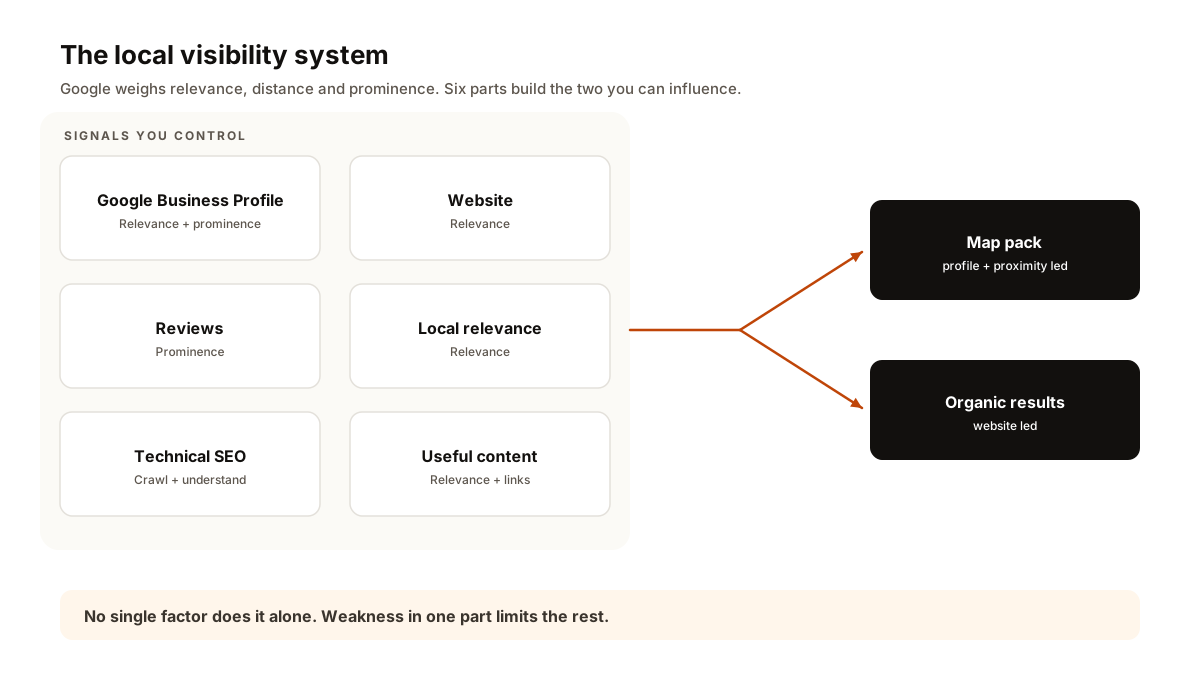
Google says local results are based mainly on three factors, as its Business Profile help documentation explains:
- Relevance: how well your profile and website match what someone searched for.
- Distance: how far your business is from the searcher, or from the location in the search.
- Prominence: how well known your business is, reflected in reviews, links, mentions and overall web presence.
Google also states that you can't pay for better local ranking. You can't change your distance from a searcher. You can strongly influence relevance and prominence, and that's where the website does much of the work.
There are two surfaces to think about. The map pack (the map with three listings) leans heavily on your Business Profile and proximity. The regular organic results below it lean on your website. A strong local presence shows up in both.
The system: six parts that reinforce each other
Think of local visibility as:
Google Business Profile + website + reviews + local relevance + technical SEO + useful content
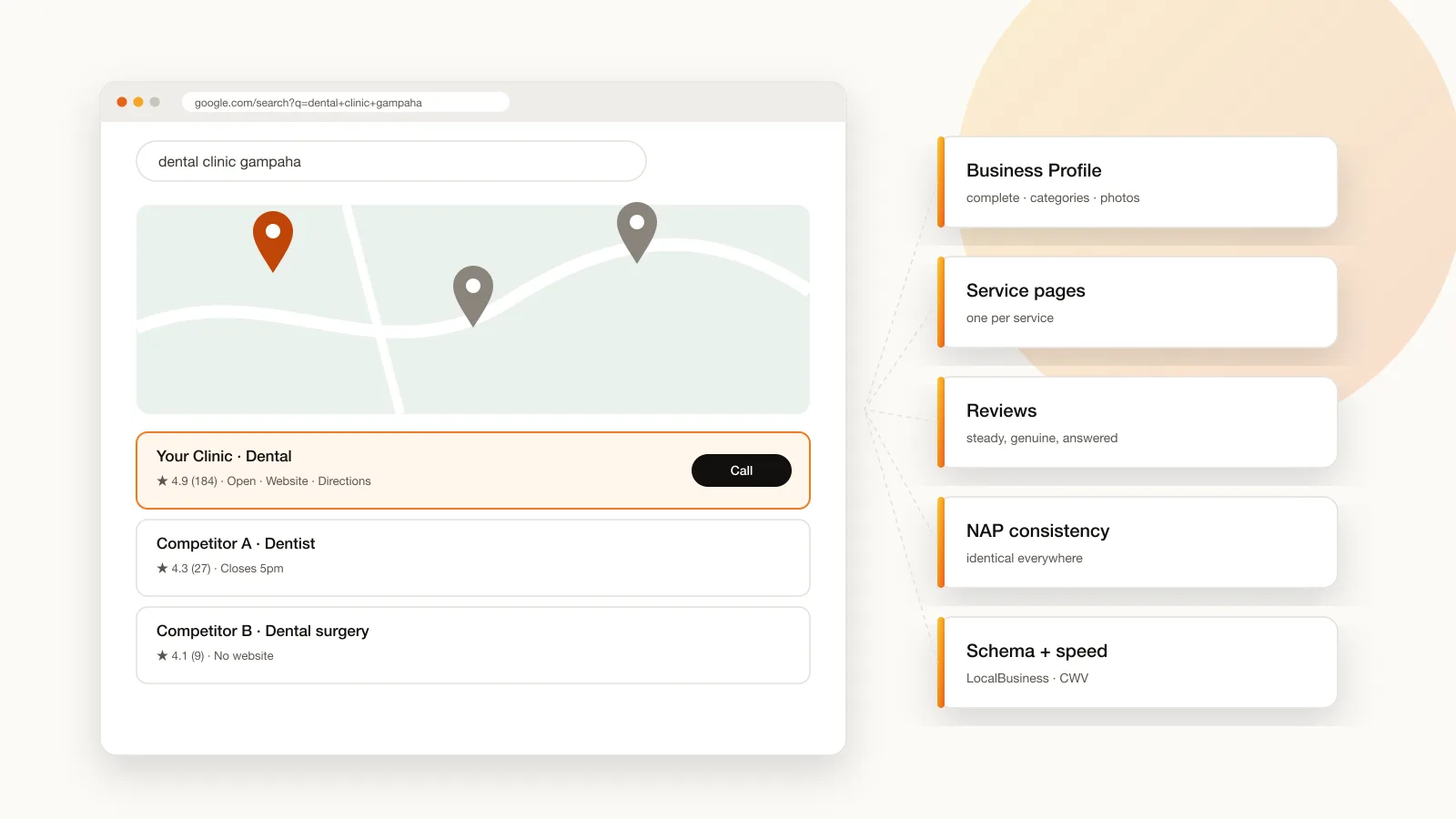
Each part supports the others. Reviews make the profile more prominent. The website gives Google the detail to judge relevance. Technical SEO makes sure that detail can be crawled and understood. Useful content earns links and mentions, which add prominence. If one part is missing, the others work harder for less.
Below are the fifteen building blocks, grouped by what they contribute.
Your profile and your reputation
1. Google Business Profile
Your Business Profile is often the first thing a local searcher sees. Complete every relevant field: the most accurate primary category (plus secondary categories that genuinely apply), services, hours, holiday hours, attributes, photos of your premises and work, and a description written for customers. Follow Google's guidelines for representing your business: use your real business name without added keywords, and list your address only if customers visit you there.
Our Google Business Profile setup guide walks through verification and optimisation step by step.
2. NAP consistency
NAP stands for name, address and phone number. They should be identical on your website, Business Profile, Facebook page, directory listings and anywhere else they appear. Small differences ("No. 12, Main St" versus "12 Main Street", or an old mobile number) make it harder for search engines to connect the mentions confidently.
Choose one format, use it everywhere, and update old listings when anything changes.
3. Reviews
Reviews influence both prominence and the decision a searcher makes. Ask every satisfied customer, make it easy with a direct review link, and reply to reviews, including critical ones, politely and specifically. Don't buy reviews, write them yourself or gate them so only happy customers are asked. These practices break Google's policies and erode trust.
4. Local citations and backlinks
Citations are mentions of your business details on other sites: business directories, chambers of commerce, industry associations and local listings. Backlinks from relevant local sources, such as a supplier, a community organisation you sponsor, local news coverage or a partner business, add prominence. Focus on quality and relevance, not volume. A handful of genuine local links beats hundreds of directory submissions.
Your website's local relevance
5. Website location relevance
Your website should make it clear where you are and where you work, through your address in the footer and on the contact page, an embedded map, the areas you serve, and content that reflects real local context. Consistency with your Business Profile matters more than repetition.
6. Service pages
This is where most small-business websites fall short. If you offer five services and describe them all on one page, you're asking one page to rank for five different searches. Give each core service its own page with a clear title, a specific description, pricing guidance where possible, FAQs, proof, and a clear next step.
A dental clinic in Gampaha town, for example, is more likely to be relevant for "dental implants" and "teeth whitening" with a page for each than with a single "Our Services" list.
7. Location pages, only where genuine
If you serve several towns, a page for a specific area can help, if it's genuinely useful. That might mean which services you offer there, coverage and response times, directions, local projects or considerations specific to that area. A tuition centre with branches in Gampaha and Minuwangoda has real reasons for two pages. A plumber serving Yakkala and Veyangoda from one base might have one well-written service-area page rather than ten thin ones.
Our article on ranking in towns where you don't have an office explains what's realistic and what isn't.
8. Useful local content
Content earns visibility when it answers questions local customers actually ask: "what documents do I need for…", "how much does … cost in Gampaha", "which option suits a home in a flood-prone area", "how long does delivery to Mirigama take". Useful content attracts links and mentions, gives search engines and AI assistants clear answers to cite, and builds trust before a customer calls. Google's guidance on helpful, people-first content is a good test for anything you publish.
9. Internal linking
Link related pages together so both visitors and search engines can follow the structure: service pages linked from the homepage and from relevant articles, location pages linked from service pages where relevant, and case studies linked to the services they demonstrate. Use descriptive link text such as "dental implants in Gampaha", not "click here".
Why simply putting "Gampaha" everywhere doesn't work
A common approach to local SEO is to repeat the town name as often as possible: "Best web design Gampaha. We are a web design Gampaha company offering web design Gampaha services to Gampaha businesses." Some sites go further and create dozens of near-identical pages, one per town, with only the name swapped.
It doesn't work, for three reasons.
It's what Google specifically warns against. Google's spam policies name keyword stuffing and doorway pages, meaning pages created to rank for similar searches that funnel users to the same place, as practices that can lower rankings or remove pages from results.
It doesn't add relevance. Search engines understand language and context. Repeating a word doesn't give them new information. Describing what you do, for whom, where and how does.
It puts customers off. A page that reads like it was written for a machine signals low quality to the person deciding whether to call you.
Compare these two approaches:
| Keyword stuffing | Genuine local relevance |
|---|---|
| "Gampaha" in every sentence and heading | The town mentioned naturally where it's relevant |
| Identical pages for 20 towns with the name swapped | Pages only for areas you genuinely serve, each with specific detail |
| Generic claims ("best in Gampaha") | Specifics: coverage, response times, local projects, prices |
| Hidden keyword lists in the footer | A clear address, map and service-area statement |
| Fake addresses to appear local | One real, verified address, used consistently |
The technical foundation
10. Technical SEO
Search engines have to crawl, render and understand your pages before any of the above counts. The basics are: every important page indexable, unique titles and meta descriptions, one clear H1 per page, logical headings, canonical tags, an XML sitemap, no broken links, and redirects when URLs change. Our SEO audit checklist covers the full list.
11. Schema markup
Structured data helps search engines interpret your business details. Use LocalBusiness or a more specific type (Dentist, MedicalClinic, Restaurant, Store and so on) with your name, address, phone, geo-coordinates, opening hours and service area, following Google's LocalBusiness structured data guidelines. Add BreadcrumbList for site structure and Organization for your brand. Mark up only what's visible on the page, and don't add review ratings you can't substantiate.
12. Mobile performance
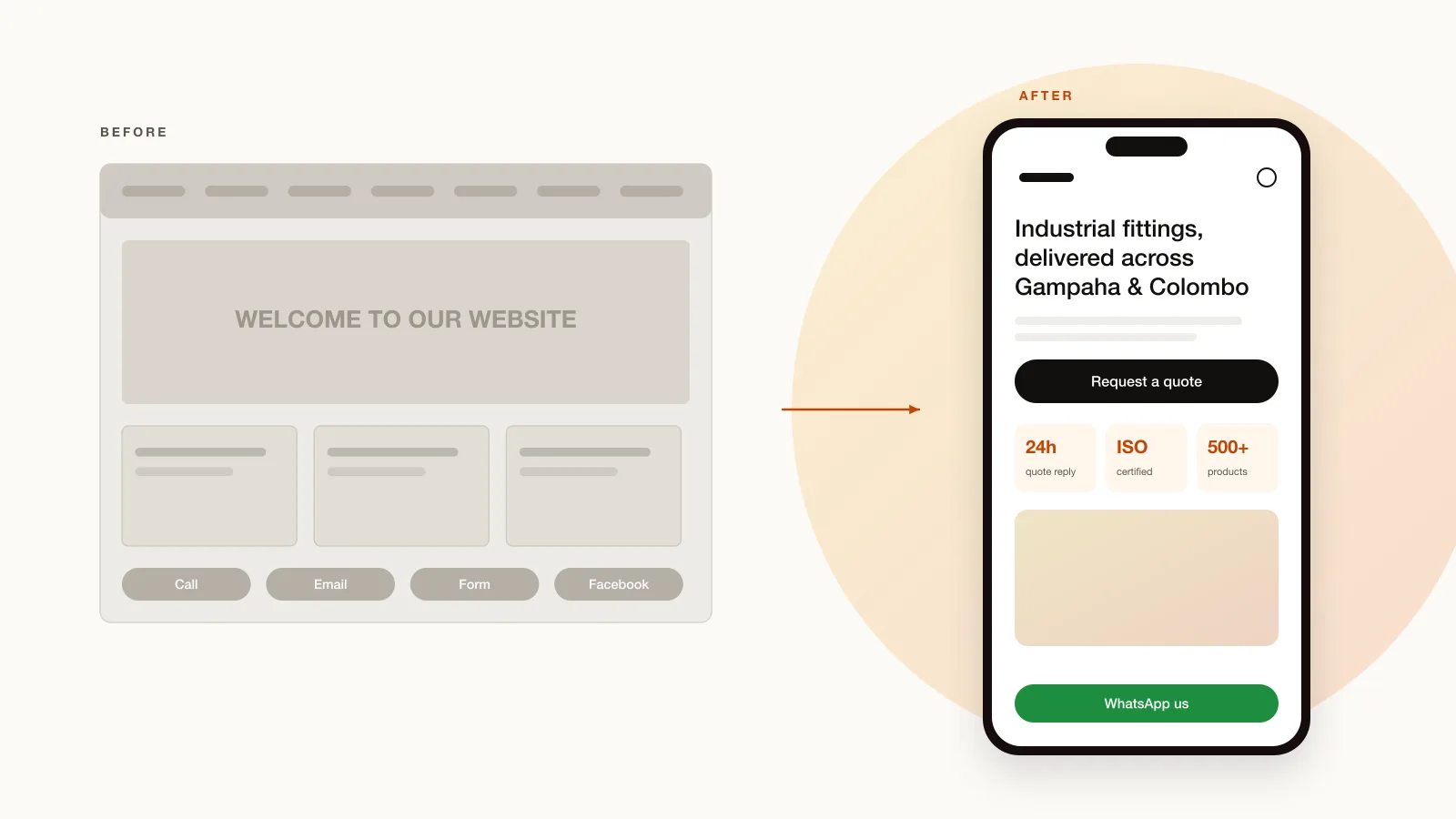
Most local searches happen on phones, often by someone deciding right now where to go or whom to call. Tap-to-call, WhatsApp, directions and opening hours should be reachable within the first screen on mobile, and forms should be short and easy to complete with a thumb.
13. Page speed
Slow pages lose local customers before they see your offer. Aim for Google's Core Web Vitals thresholds: Largest Contentful Paint within 2.5 seconds, Interaction to Next Paint under 200 milliseconds, and Cumulative Layout Shift under 0.1. The usual fixes are properly sized modern images, lighter themes, fewer plugins and better hosting.
Turning visibility into customers
14. Conversion paths
Visibility is only useful if it turns into enquiries. Every service page needs a clear next step suited to the customer: call, WhatsApp, book an appointment, request a quote or get directions. Remove distractions near the call to action, show proof (reviews, photos, credentials) close to it, and keep forms short.
15. Analytics and Search Console
Connect Google Search Console to see which searches show your site, which pages appear, and whether Google can crawl everything. Set up analytics with conversion events for calls, WhatsApp clicks, form submissions and direction requests. Check Business Profile insights monthly as well. Together they show which parts of the system are working and where to focus next.
Does having a Gampaha address help?
Yes, for searches made near that address, because distance is a ranking factor. But an address is a starting point, not a strategy. Two businesses on the same Gampaha street can have very different visibility because of differences in relevance and prominence.
If your customers don't visit your premises, Google's guidelines say to set up as a service-area business, hiding the address and listing the areas you serve. Never use a virtual office, a relative's house or a fake address to appear in a town where you don't operate. It violates Google's guidelines and risks suspension of your profile.
What this looks like in practice
Our work for St Luke's Medical Laboratory, a diagnostic lab in Ja-Ela in the Gampaha district, shows the system working together. The site was structured with one page per test category, a transparent price list, and home-collection pages for the suburbs the lab actually serves, including Kandana, Welisara, Ragama and Wattala. We added LocalBusiness and MedicalClinic structured data, kept name, address and phone consistent across Google Business Profile, Bing Places and Apple Maps, and tuned page titles to the searches patients actually make.
None of these steps was clever on its own. The result came from doing all of them consistently.
A practical 90-day starting plan
| Weeks | Focus | Actions |
|---|---|---|
| 1–2 | Audit and foundations | Audit profile, website and citations; fix NAP inconsistencies; set up Search Console and conversion tracking |
| 3–4 | Business Profile | Complete every field, choose categories carefully, add real photos, set up a review request process |
| 5–8 | Website structure | Build or improve one page per core service; add genuine location or service-area content; add structured data; fix speed issues |
| 9–12 | Content and prominence | Publish useful answers to common customer questions; pursue relevant local links and citations; review data and adjust |
This isn't a guarantee of rankings. No honest plan is. It's the order that tends to produce the most improvement for the effort, because it fixes the foundations before adding content.
Where to start
Search for your three most important services the way a customer would, on your phone, from where your customers are. Note who appears, what their profiles and websites have that yours doesn't, and where your own details are inconsistent. That comparison is the start of a useful brief.
For a broader national view, our local SEO guide for Sri Lankan businesses covers the full playbook. If you're in a smaller town near the Colombo boundary, see how Kandana and Ragama businesses can outrank bigger competitors. And if your current website is the weak link, the ten signs a website needs a redesign will help you decide what to fix. For tourism businesses on the coast, see how Negombo hotels and restaurants turn visits into bookings.
Uniix Studio is a Colombo-based creative digital agency providing local SEO, web design and website development for businesses across the Gampaha district, including Gampaha, Ja-Ela, Kandana, Wattala, Negombo, Yakkala, Veyangoda and Minuwangoda.
Frequently asked questions
Does having a Gampaha address help local SEO?
A verified address in or near Gampaha helps with searches made nearby, because distance is one of Google's three local ranking factors. But an address alone doesn't guarantee visibility. Relevance and prominence, built through a complete Business Profile, a relevant website and reviews, matter too. Never create a fake or virtual address to appear local. It breaks Google's guidelines and can get a profile suspended.
Can I rank in Gampaha if my office is somewhere else?
You can rank in regular organic results for Gampaha-related searches from anywhere, if you have genuinely useful pages about how you serve the area. Map-pack visibility is harder without a nearby location, because distance matters there. Service-area businesses can list the areas they serve on their Business Profile, but ranking in the map pack far from the business address is limited.
How long does local SEO take to work?
Fixing an incomplete or inaccurate Business Profile can improve map visibility within weeks. Building organic rankings for competitive service terms usually takes three to six months of consistent work, and longer in crowded categories. Anyone guaranteeing a specific ranking or timeframe is overpromising.
Do I need a separate page for every town I serve?
Only for towns where you genuinely serve customers and can write something specific and useful: which services you offer there, coverage, travel times, relevant projects or local considerations. Near-identical pages with only the town name swapped are treated as doorway pages and can hurt the whole site.
Is a Google Business Profile enough without a website?
A profile alone can bring map visibility and calls, but it's limited. A website lets you explain each service in depth, rank in organic results beyond your immediate area, publish prices and proof, and control how enquiries are captured. The profile and website also reinforce each other when their details match.
How many Google reviews does a local business need?
There's no fixed number. What matters is a steady flow of genuine reviews that reflect real customers, with responses from the business. Compare yourself with the businesses that currently appear for your main searches. Never buy reviews or offer incentives that break Google's policies.
What does a local SEO audit include?
A useful audit checks your Business Profile's completeness and categories, name-address-phone consistency across directories, the website's service and location pages, technical health (crawlability, speed, mobile usability, structured data), reviews, local links and citations, and whether enquiries are tracked in analytics and Search Console.
Related services
Where Uniix Studio can help
SEO Services
Technical SEO, content clusters, local SEO, AEO and GEO for 2026.
Web Design
Fast, brand-led, conversion-focused websites built on modern stacks.
Web Development
Next.js, WordPress, headless and bespoke builds.
Analytics & Reporting
GA4, server-side tracking, attribution, dashboards and reporting that actually drives decisions.
Next step
Not appearing for local searches?
Start with a technical and local SEO audit. We'll check your Business Profile, website structure, citations and tracking, and give you a prioritised list of what to fix first.