Medical Lab and Clinic Website Design in Sri Lanka: What Patients Need to See
Patients choose a lab or clinic on their phone, usually by price, place and trust. Here's what a Sri Lankan healthcare website needs to answer, based on building one for an independent lab in Ja-Ela.
Uniix Studio
Founder · Uniix Studio
In brief
- Patients search by test, price and town. A healthcare website should have a page that answers each of those searches directly.
- Trust has to be shown: named and qualified reviewers on health content, real premises, clear hours and honest claims.
- Make contact effortless on a phone (call, WhatsApp, home-visit booking), and treat patient data carefully ahead of the PDPA provisions that apply from 1 January 2027.
Contents
- 01What should a medical lab or clinic website include?
- 02Start with how patients search
- 03Publish prices if you can keep them accurate
- 04Build a page for every town you genuinely serve
- 05Show your credibility, don't claim it
- 06Publish health content when patients need it
- 07Make contact effortless on a phone
- 08Handle patient data with care
- 09Technical foundations that help search engines
- 10A checklist for your healthcare website
- 11The short version
Most people choose a medical lab or clinic on their phone, often in a hurry. They need a blood test before a doctor's appointment, a pre-employment medical by Friday, or a home visit for an elderly parent. They search, glance at a few results and contact whoever answers their question fastest.
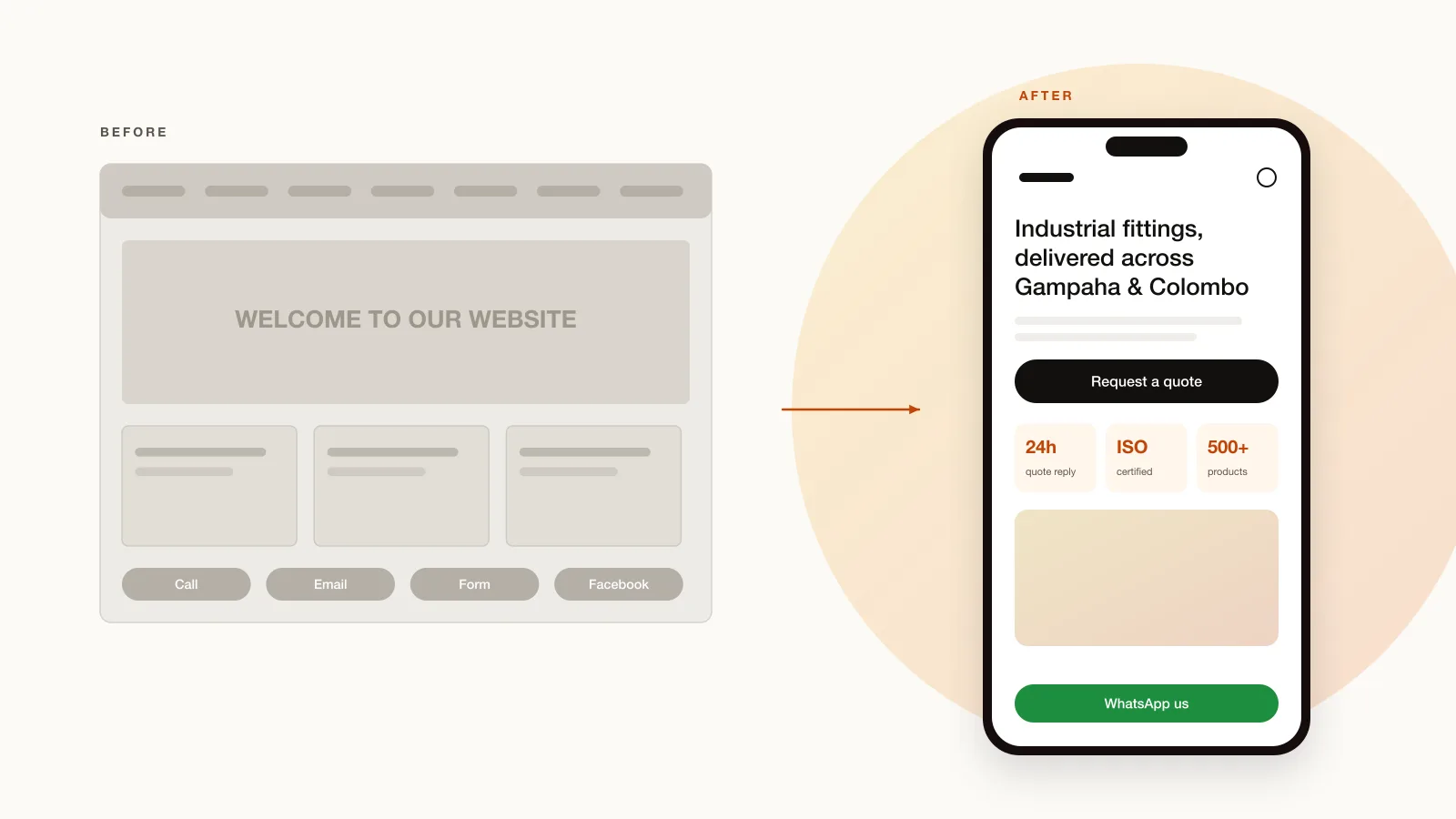
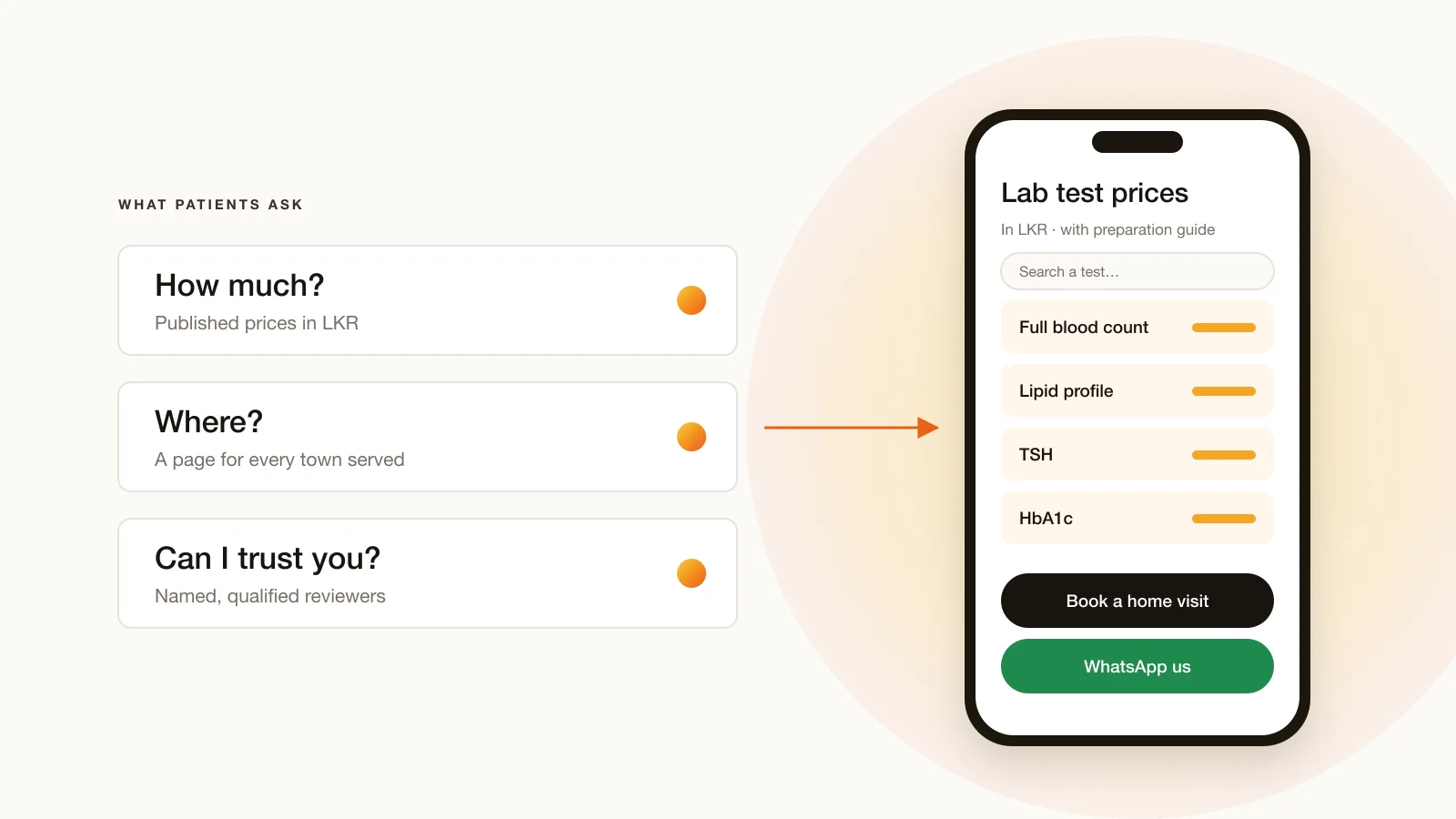
That question is usually some combination of three things: how much will it cost, is it near me, and can I trust them. Most Sri Lankan healthcare websites answer none of them clearly. They're brochures: a welcome message, a list of departments and a phone number in the footer.
This guide is for owners and managers of labs, clinics, medical centres and specialist practices. It draws on our work with St Luke's Medical Laboratory, an independent diagnostic lab in Ja-Ela, where Uniix Studio has run design, development, SEO and content since February 2026.
What should a medical lab or clinic website include?
A medical lab or clinic website should answer the searches patients actually make: published prices for common tests or consultations, preparation instructions, a page for each town you serve, opening hours, home-visit details, and qualifications that build trust. Every page should make it easy to call, message on WhatsApp or book from a phone, and patient data should be collected carefully.
The rest of this guide explains each part and why it matters.
Start with how patients search
Patients rarely search for your name until they already know you. They search for the test, the price or the place:
- "TSH test price in Sri Lanka"
- "blood test Wattala"
- "kidney function test package"
- "pre-employment medical Katunayake"
- "ECG preparation"
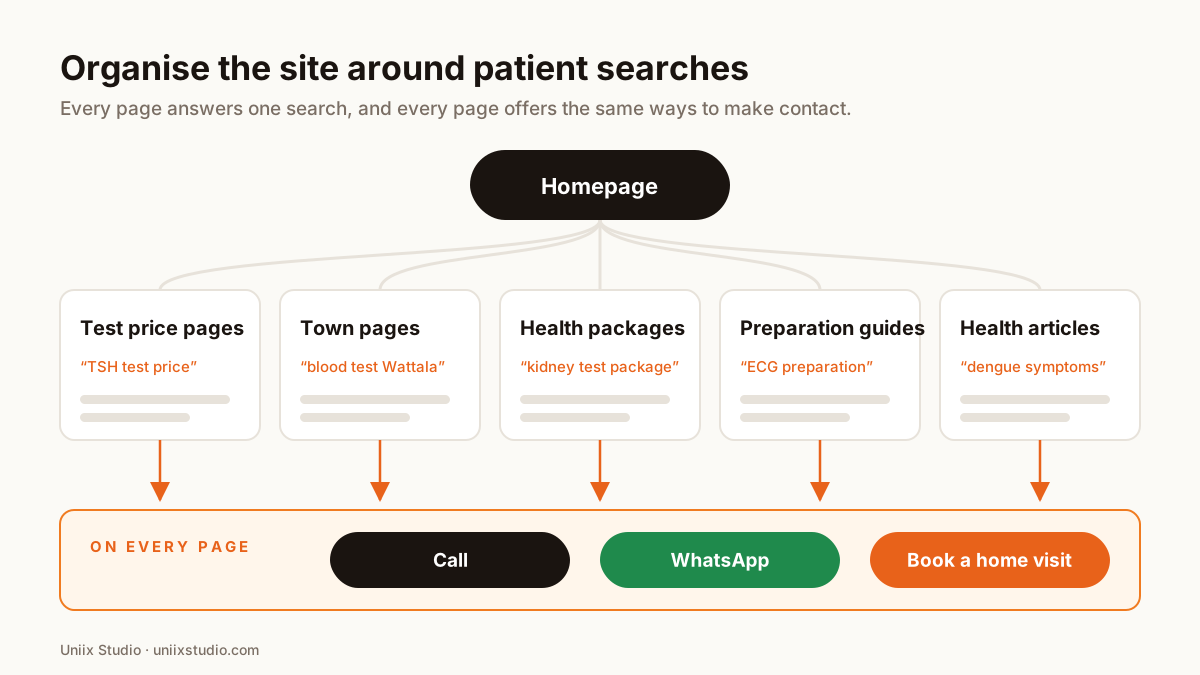
A brochure site has no page that matches any of these. So the first job is information architecture: deciding which pages exist, based on what people type, not on how the clinic organises itself internally.
For St Luke's, that meant 63 pages, each mapped to a real search: test-price pages, town pages, health packages and preparation guides. You don't need 63 pages to start. You do need one good page for each question your patients ask most often.
Publish prices if you can keep them accurate
Price is one of the biggest reasons patients compare labs, and many providers don't publish theirs. That's an opportunity for an independent lab or clinic.
St Luke's publishes 58 test prices in LKR across 12 categories in a searchable price finder, each with a preparation guide, plus four bundled health packages. Nineteen of the most-searched tests have their own landing page. The point isn't to be the cheapest. It's to answer the question before the patient has to phone and ask.
If you publish prices:
- Show them in LKR and say what's included, such as collection or report delivery.
- Add preparation instructions next to each test: fasting, timing, what to bring.
- Show the date the list was last updated, and actually update it.
- Explain packages in plain language. "Kidney package" means little; a short list of what it checks means a lot.
If you can't publish exact prices, publish ranges or "from" prices, and say why some tests vary.
Build a page for every town you genuinely serve
Healthcare is local. People want a lab they can reach before work, or one that sends someone to their home. Location pages help them, and help search engines understand where you operate.
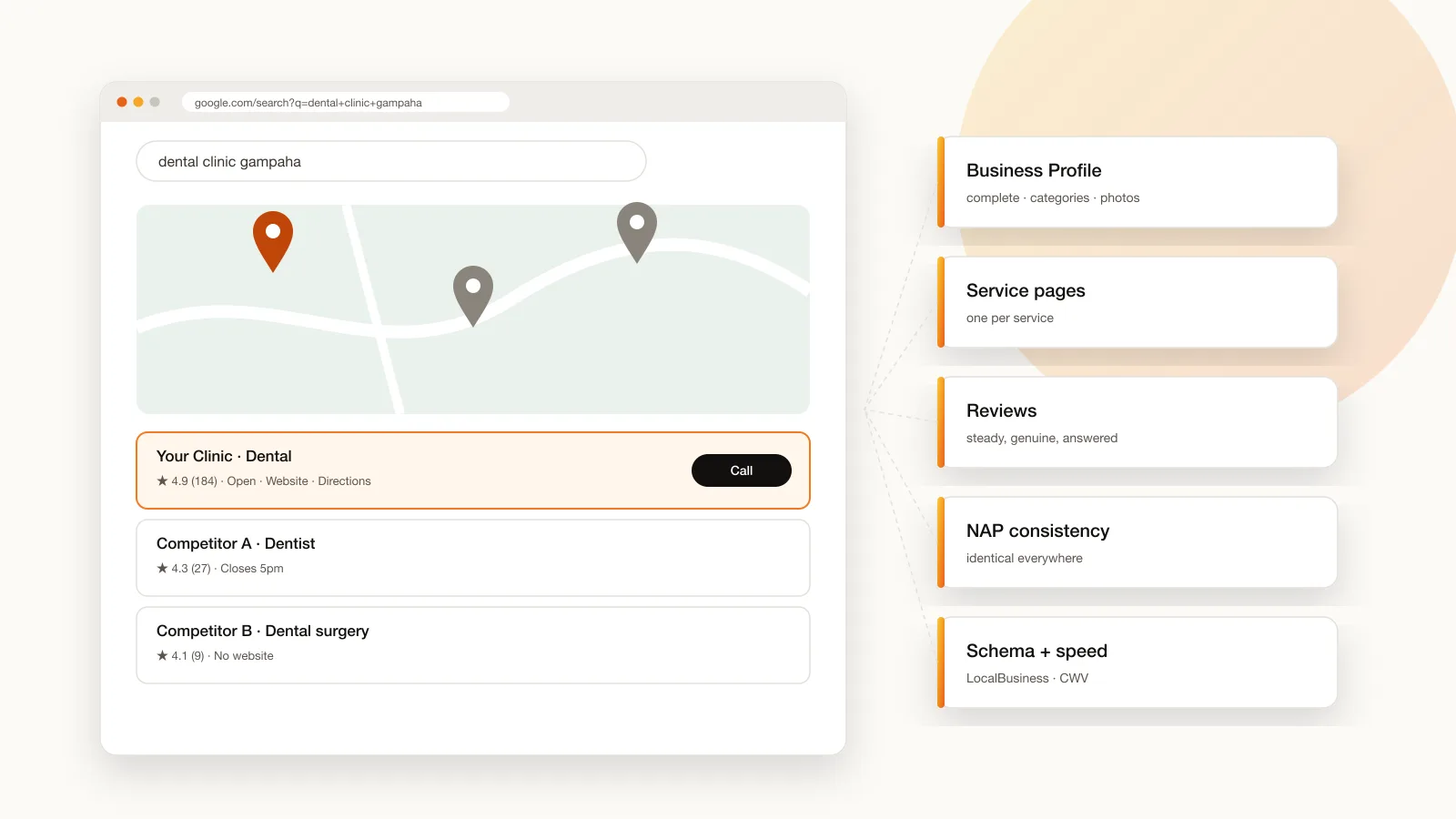
St Luke's has 10 town pages: seven walk-in towns and three home-visit areas, from Ja-Ela to Negombo. Each one has its own introduction, nearby landmarks, local FAQs and a map linked to the lab's Google Business Profile. The Katunayake page focuses on pre-employment and visa medicals for airport and Free Trade Zone workers, because that's what people there need.
The rule is simple: only create a town page if you really serve that town, and make each one genuinely different. Swapping the town name in identical copy helps nobody. Our guide to local SEO and web design in Gampaha explains how location pages and your Business Profile work together.
Show your credibility, don't claim it
Health is a high-stakes topic. Google's guidance on creating helpful, reliable, people-first content asks whether content shows clear expertise and who created it, and patients ask the same questions in their own way.
Credibility on a healthcare site comes from specifics:
- Named, qualified reviewers. Every St Luke's health article is reviewed by a qualified medical laboratory technologist, named in the byline.
- Real premises and real people. Photos of your actual lab, reception and equipment, not stock images of smiling doctors.
- Clear facts. Opening hours, address, phone number and parking, identical everywhere they appear online.
- Honest language. Avoid claims you can't support, such as "the most accurate lab" or "guaranteed results". Professional bodies and regulators may also have rules on how healthcare providers advertise, so check what applies to you.
Publish health content when patients need it
Useful health articles bring patients to you before they've decided where to go. They work best when they answer real questions in plain language and are published when people are searching.
St Luke's has published 20 MLT-reviewed articles covering dengue, leptospirosis, Vitamin D, thyroid tests, HbA1c, fatty liver, lipid profiles, ECG preparation, pre-employment medicals and home blood tests. During the June 2026 dengue spike, we published dengue articles in English and Sinhala while people were actively looking for answers. Three of the articles are in Sinhala.
Some practical rules for health content:
- Answer the main question in the first paragraph.
- Explain when to see a doctor, and don't diagnose.
- Link to authoritative sources, such as the Ministry of Health or WHO, for clinical facts.
- Translate the content your patients use most, with a qualified reviewer checking the translation. Our guide to Sinhala, Tamil and English websites covers how to structure this.
Our content marketing service handles research, writing and coordinating professional review.
Make contact effortless on a phone
Most patients will arrive on a phone, often on mobile data. The site has to load quickly and make the next step obvious.
Every St Luke's page offers five ways to get in touch: click-to-call, WhatsApp, an AI chat assistant, a sticky mobile action bar and home-visit booking. The site is built mobile-first, with 44-pixel minimum tap targets.
For your site:
- Put call and WhatsApp within thumb's reach on every page.
- Make home visits a clear option if you offer them, with the areas covered and how to book.
- Keep forms short. Name, phone, preferred time and the test or service is usually enough.
- Make it fast. Google's Core Web Vitals set useful targets: content visible within 2.5 seconds, responses to taps within 200 milliseconds, and little layout shift. St Luke's loads in about half a second on desktop, with zero layout shift.
If you're considering full online appointment booking, our guide to online booking systems explains when it's worth building.
Handle patient data with care
Health information is about as personal as data gets. Sri Lanka's Personal Data Protection Act, No. 9 of 2022, is being brought into force in stages, with a July 2026 gazette setting 1 January 2027 for key provisions. Take legal advice on your obligations, but some website practices are sensible regardless:
- Collect the minimum. A booking form doesn't need medical history.
- Don't send reports through a general contact inbox. If patients get results online, use a proper secure system.
- Explain what you collect and why in a privacy notice written for patients, not lawyers.
- Limit who can see submissions, and remove access when staff leave.
- Be careful with tracking scripts on pages where people enter health-related details.
Technical foundations that help search engines
The technical work is invisible to patients, but it decides whether search engines understand your site. For St Luke's this included canonical URLs, one clear heading per page, generated share images for every page and structured data across 22 schema.org types. Schema.org has specific types for healthcare businesses, such as DiagnosticLab and MedicalClinic.
Structured data doesn't guarantee rich results or rankings. It helps search engines read facts like your name, address, opening hours and services accurately. The result for St Luke's is a 100/100 Lighthouse SEO score on mobile and desktop, 100/100 Best Practices and 97/100 Accessibility. Those scores measure technical quality, not rankings, but they remove avoidable obstacles. Our SEO services cover this foundation.
A checklist for your healthcare website
| Area | What to check |
|---|---|
| Prices | Common tests or consultations in LKR, with what's included and a last-updated date |
| Preparation | Fasting, timing and what to bring, next to each test |
| Locations | One genuinely local page per town you serve, matching your Business Profile |
| Trust | Named, qualified reviewers; real photos; honest claims |
| Content | Plain-language answers to common questions, reviewed by a professional |
| Languages | Key pages in Sinhala or Tamil where your patients need them |
| Contact | Call, WhatsApp and home-visit booking on every page, easy on a phone |
| Speed | Fast on mobile data; check Core Web Vitals |
| Privacy | Minimal forms, a clear privacy notice, secure handling of results |
| Measurement | Track calls, WhatsApp clicks and bookings, not just visits |
The short version
A healthcare website earns patients by answering their questions faster and more honestly than the alternatives: what it costs, where you are, how to prepare and why they can trust you. Build pages around those questions, prove your credibility with specifics, make contact effortless on a phone, and treat patient data carefully.
If you'd like to see how this works in practice, the St Luke's case study walks through the full project, and our web design team can review your current site.
Frequently asked questions
Should a medical lab publish its test prices online?
In our experience, yes, if the prices are kept accurate. Many patients search for a specific test price before they choose a lab, and a page that answers that search can bring them to you directly. Publish prices in LKR, say what's included, add the preparation instructions, and show when the list was last updated.
What pages does a clinic or lab website need?
At minimum: a homepage with clear contact actions, a services or test list, prices where you can publish them, preparation guides, a page for each location or town you serve, opening hours, home-visit information if you offer it, an about page with qualifications, and contact details that match your Google Business Profile.
Can a clinic website collect patient information through a form?
It can, but collect only what you need to arrange the appointment, explain why you're collecting it, and keep it in a secured system rather than a shared inbox. Avoid asking for medical history or reports through a general contact form. Sri Lanka's Personal Data Protection Act provisions that take effect on 1 January 2027 make this more important.
Who should write health articles on a medical website?
A writer can draft them, but a qualified professional in that field should review every article, and their name and qualification should appear on the page. Health topics carry real risk for readers, and both patients and search engines look for evidence of expertise.
Should a Sri Lankan clinic website be in Sinhala or Tamil?
If many of your patients prefer Sinhala or Tamil, translate the pages they use most: preparation guides, health articles and contact information. Use separate URLs for each language and have a qualified person review the translations, especially for medical instructions.
How long does it take to build a medical lab website?
A focused site with a price list, location pages and contact flows typically takes several weeks, depending on how quickly prices, photos and reviewed content are ready. Content usually takes longer than development, so start gathering it early.
Related services
Where Uniix Studio can help
Web Design
Fast, brand-led, conversion-focused websites built on modern stacks.
SEO Services
Technical SEO, content clusters, local SEO, AEO and GEO.
Content Marketing
Editorial strategy, long-form content, distribution and repurposing for SEO + AEO + GEO.
UI/UX Design
UI/UX design in Sri Lanka for web and mobile that turns visitors into customers.
Next step
Running a lab, clinic or medical centre?
Send us your current website, or tell us you don't have one. We'll show you which patient searches you're missing and what a site built around them would include.